
¿Es la fabricación aditiva por moldeo por inyección? Respuesta clara
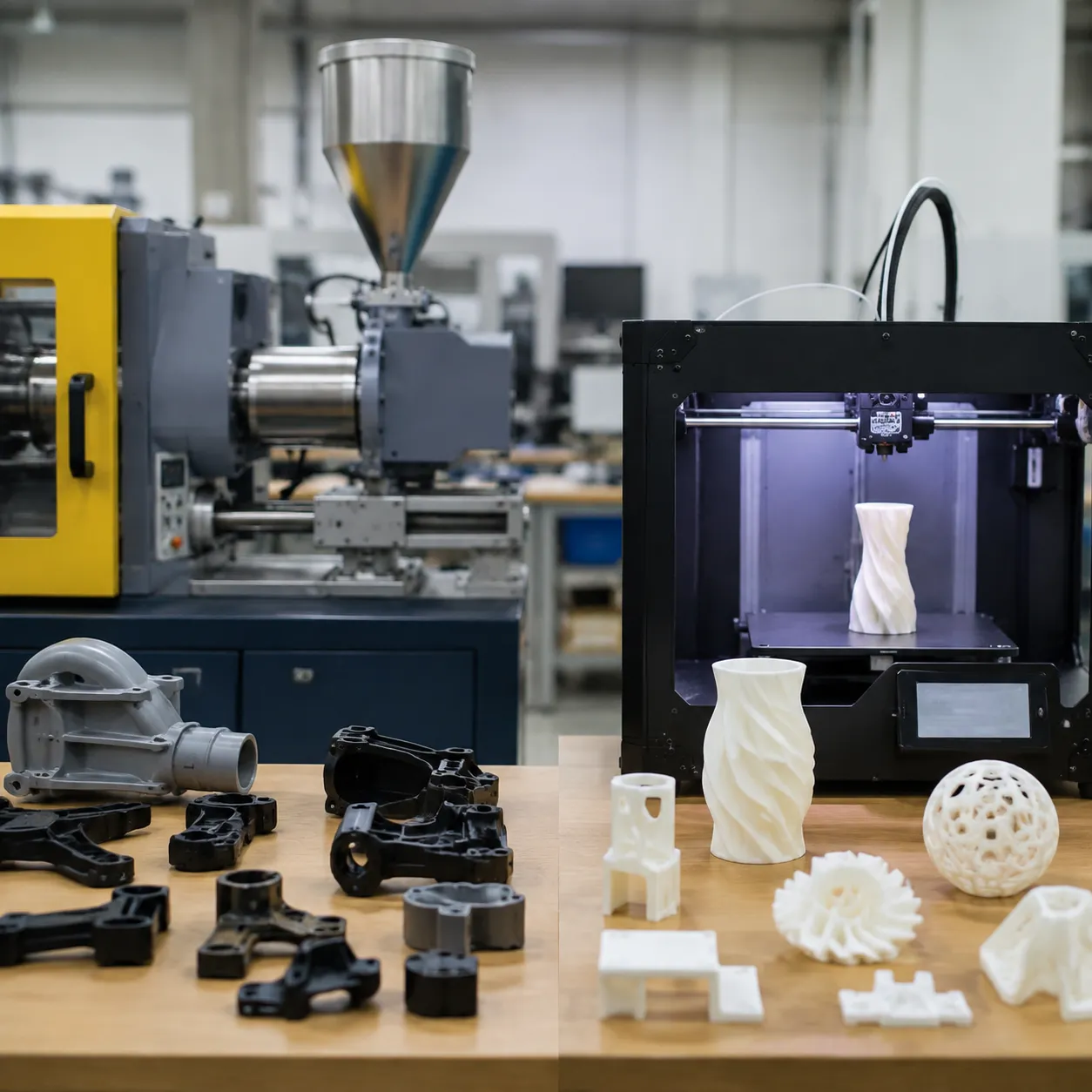
No, el moldeo por inyección no es fabricación aditiva. Aunque ambas técnicas producen componentes plásticos de alta calidad, se basan en mecanismos de producción fundamentalmente diferentes.
El moldeo por inyección da forma al material fundido usando una presión extrema dentro de una cavidad personalizada, convirtiéndolo en un proceso clásico de fabricación formativa En cambio, la impresión 3D se basa en fabricación capa por capa para construir piezas desde cero.
Fabricación Formativa vs. Fabricación Aditiva
Comprender cómo se manipulan las materias primas destaca por qué estas tecnologías sirven en diferentes etapas de producción.
| Categoría de fabricación | Mecanismo principal | Estado del material | Tecnologías principales |
|---|---|---|---|
| Formativa | Da forma a material líquido o maleable usando calor, fuerza y herramientas pesadas | Líquido / Fundido | Moldeo por inyección de plástico, estampado de metales |
| Aditivo | Construye piezas de forma incremental directamente a partir de archivos de diseño 3D digitales | Filamento, Polvo, Resina Líquida | Impresión 3D (FDM, SLA, SLS) |
| Sustractivo | Corta el material no deseado de un bloque sólido | Bloque Sólido | Mecanizado CNC, Fresado, Torno |
Diferencias clave entre el moldeo y la impresión 3D
-
- Requisitos de las herramientas: El moldeo por inyección requiere moldes metálicos de alta precisión antes de que comience la producción. La fabricación aditiva no requiere utillaje, imprimiendo piezas directamente a partir de modelos CAD digitales.
- Velocidad de producción: Una vez completado el utillaje, el moldeo produce piezas en segundos. La impresión 3D procesa piezas individuales a lo largo de horas.
- Integridad del material: Las piezas moldeadas utilizan material completamente fundido resinas termoplásticas bajo alta presión de compactación, lo que produce una resistencia mecánica uniforme y acabados superficiales lisos superiores a los de las capas impresas.
Por qué el moldeo por inyección se clasifica como un proceso formativo
Clasificamos el moldeo por inyección estrictamente como un proceso formativo porque la materia prima experimenta un cambio de fase completo sin añadir ni eliminar volumen. El plástico líquido llena una cavidad preformada, adopta la forma precisa de dicha cavidad y se solidifica. La masa de resina introducida en la máquina es igual a la masa de la pieza final; se remodela, no se construye capa por capa.
Cómo funciona el moldeo por inyección frente a la fabricación aditiva
El proceso de moldeo por inyección
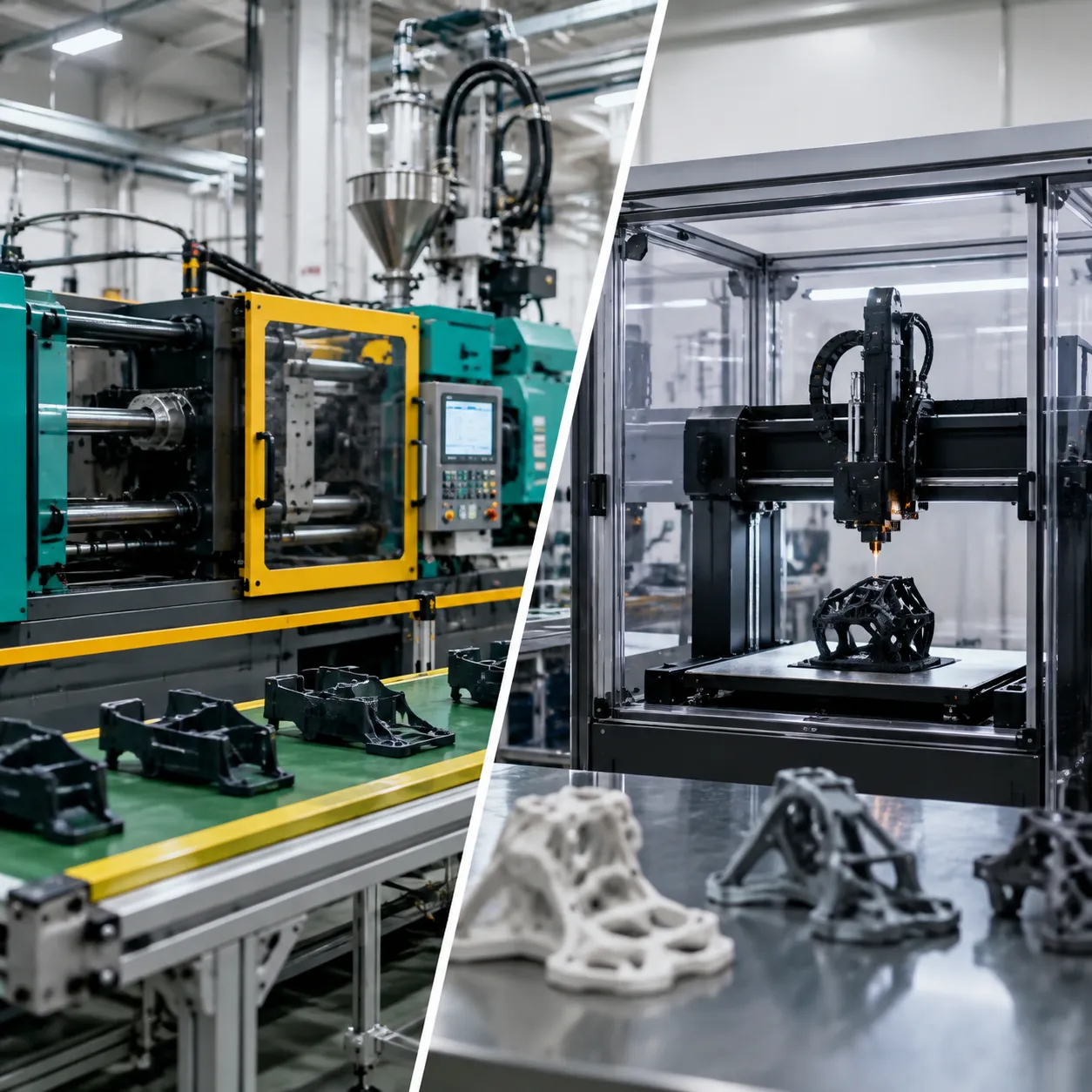
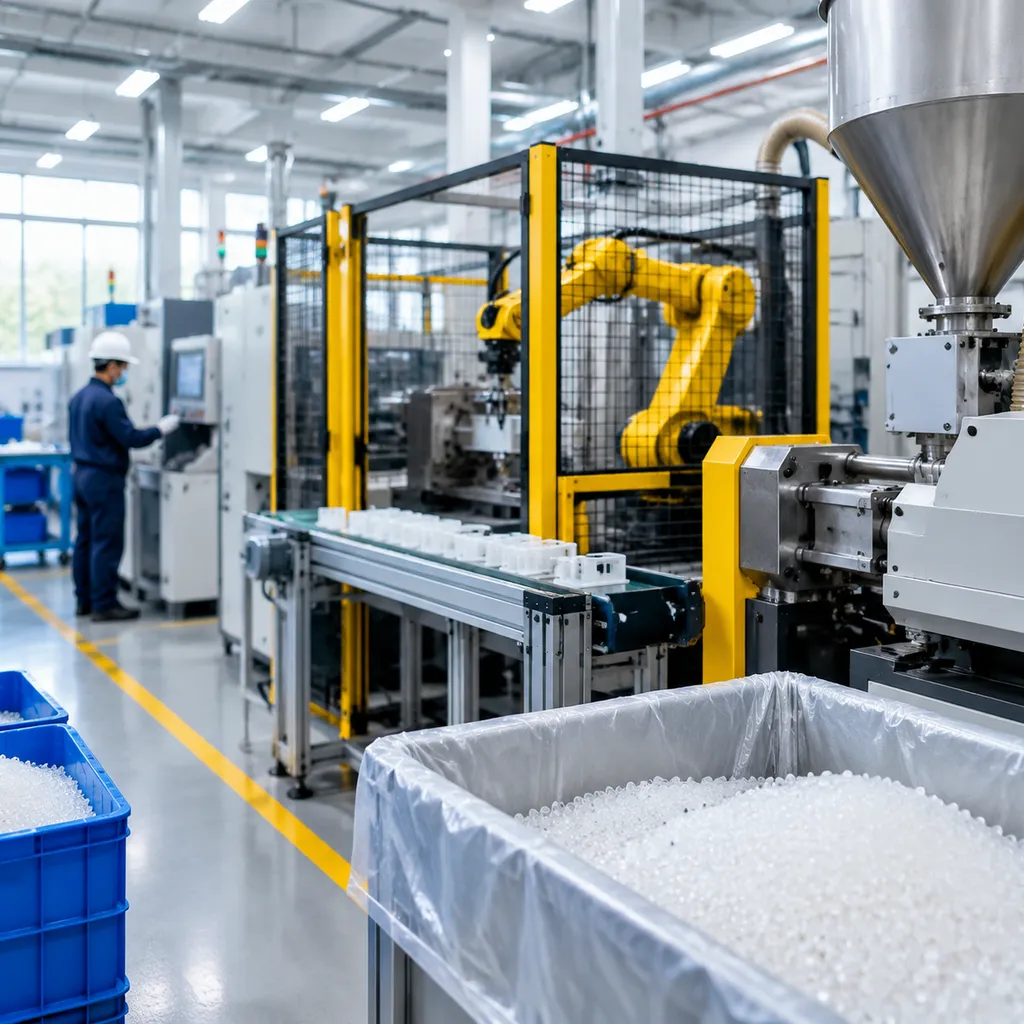
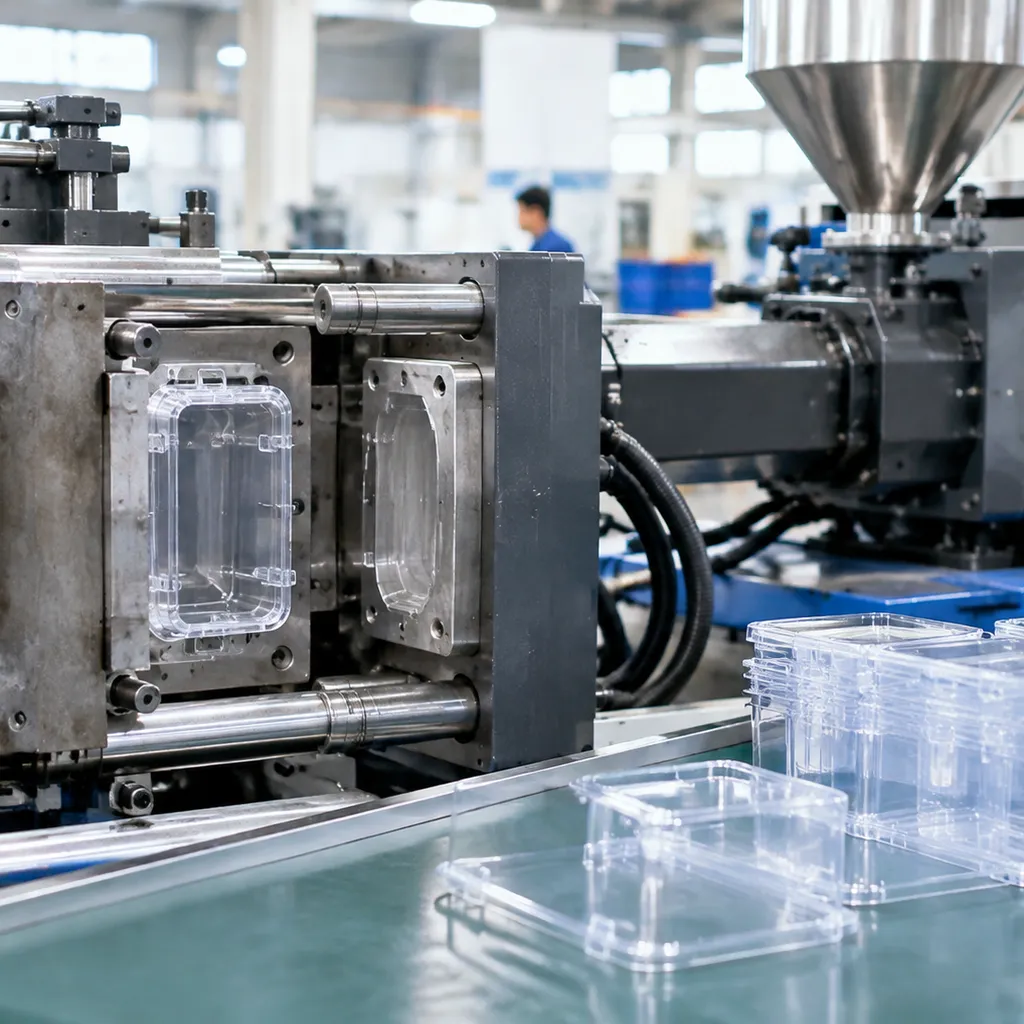
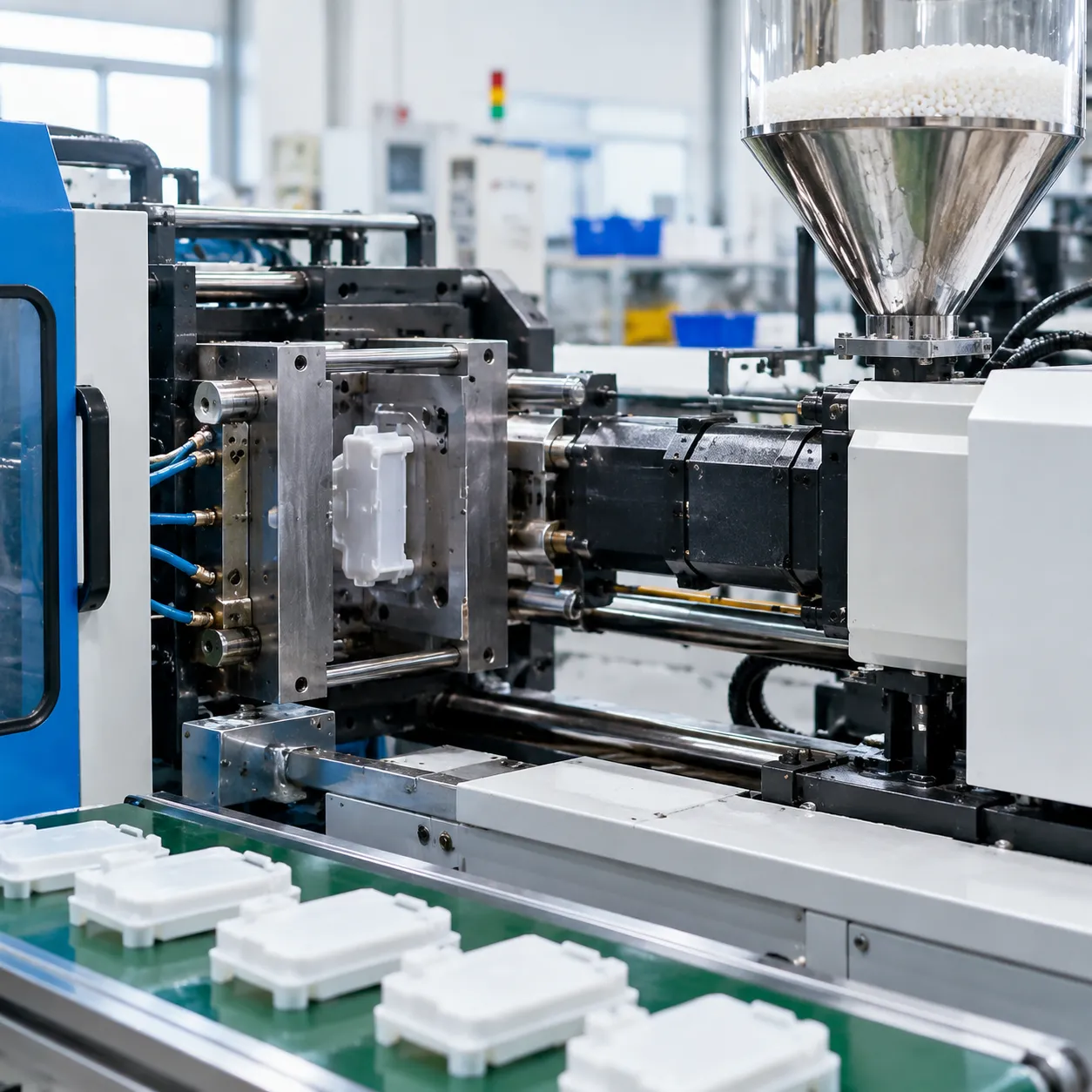
El moldeo por inyección de plástico se basa en alta presión y utillaje de precisión. Fundimos resinas termoplásticas dentro de un cilindro calefactado e inyectamos el líquido bajo intensa presión en un molde metálico personalizado. El material se enfría dentro de la cavidad del molde, se solidifica tomando su forma y se eyecta como una pieza terminada. Pesar la inversión inicial en utillaje frente a las necesidades de producción a largo plazo resalta la clave advantage and disadvantage of injection moulding para grandes tiradas de fabricación.
El proceso de fabricación aditiva
La fabricación aditiva construye piezas directamente a partir de un archivo CAD 3D digital sin moldes personalizados. Las impresoras 3D crean formas mediante la deposición de material capa por capa, fusionando filamento plástico, resina líquida o polvo metálico hasta que la geometría esté completa.
Requisitos de herramental y plazos de configuración
| Característica del proceso | Moldeo por inyección | Fabricación aditiva |
|---|---|---|
| Herramental requerido | Moldes personalizados de acero o aluminio | Ninguno (impresión digital directa) |
| Tiempo de entrega inicial | De 2 a 10 semanas (fabricación de moldes) | Horas a días (configuración inmediata del archivo) |
| Material Deposition | High-pressure melt injection | Layer-by-layer fabrication |
| Velocidad de producción | Seconds per part (after setup) | Hours per part |
Key Differences: Injection Moulding vs 3D Printing
Understanding whether injection moulding is additive manufacturing requires examining how each method handles scaling, tooling, and part performance. Injection moulding relies on shaping molten plastic in custom cavities, whereas 3D printing builds parts layer by layer.
| Comparison Metric | Injection Moulding (Formative) | 3D Printing (Additive Manufacturing) |
|---|---|---|
| Optimal Volume | High volume (1,000 to 1,000,000+ units) | Low volume (1 to 1,000 units), custom batches |
| Inversión en Herramientas | Alto costo inicial del molde | Zero custom tooling cost |
| Unit Cost Structure | Drops sharply as production scales | Remains constant per unit |
| Flexibilidad de Diseño | Requires draft angles and uniform walls | Handles internal voids and complex geometries |
| Part Durability | Dense, isotropic structural strength | Anisotropic, weaker layer bonds |
Scalability and Production Volume
We scale production rapidly with injection moulding once steel or aluminum molds are finalized. High-speed automation drops cycle times to mere seconds per piece. Additive manufacturing operates without tools, but building parts layer by layer keeps cycle times high, making it inefficient for high-volume mass runs.
Unit Cost vs. Upfront Tooling Investment
Custom mold creation requires significant upfront tooling capital. However, spreading this investment across large product runs drives individual unit costs down to fractions of a dollar. 3D printing avoids mold expenses entirely, making it cost-effective for prototypes. When evaluating injection and non-injection competition cost factors, production volume ultimately determines long-term ROI.
Design Flexibility and Complexity
The additive manufacturing process offers unmatched design freedom. It easily builds internal channels, lattice structures, and organic shapes without tooling constraints. Injection moulding demands strict Design for Manufacturing (DFM) rules, including draft angles, radius edges, and consistent wall thickness to ensure clean part ejection.
Material Selection, Finish, and Durability
Injection moulding delivers superior structural integrity using standard high-grade thermoplastic resins. High pressure forces molten material into the cavity, producing uniform, isotropic parts with smooth surface finishes. 3D printed parts frequently exhibit visible layer lines and structural directionality, which can compromise strength under heavy mechanical stress.
When to Choose Injection Moulding vs Additive Manufacturing
Choosing between injection moulding vs 3D printing comes down to design complexity, production scale, and project budget. While buyers often ask is injection moulding additive manufacturing, understanding when to apply each process keeps project costs low and timelines tight.
Best Use Cases for High-Volume Plastic Production
Injection moulding is the industry standard for high-volume manufacturing. Once tooling is complete, cycle times drop to seconds per part.
-
- Mass Scalability: Best for production runs exceeding 10,000 identical parts.
- Lowest Unit Cost: High upfront tooling expenses dilute rapidly, yielding the lowest unit cost available.
- Versatilidad de Material: Supports virtually all engineering thermoplastics. Reviewing para qué se utilizan los plásticos en el moldeo por inyección helps select the exact strength, heat, or flexibility requirements for your project.
When Additive Manufacturing Makes Financial Sense
Additive manufacturing eliminates setup delays and tooling costs, making it ideal for flexible, low-volume builds.
-
- Producción en Baja Volumen: Financial winner for short runs under 1,000 parts.
- Geometrías complejas: Fabricates internal channels and organic shapes without design for manufacturing (DFM) tooling constraints.
- Velocidad al Mercado: Goes directly from CAD file to physical object in hours.
Quick Decision Matrix
| Métrica | Moldeo por inyección | Fabricación aditiva |
|---|---|---|
| Optimal Volume | 10,000+ parts | 1 - 1,000 parts |
| Costo Inicial de Herramientas | High (Steel/Aluminum molds) | Zero |
| Part Cycle Time | Seconds | Hours |
| Flexibilidad de Diseño | Fixed by mold | Unlimited revisions |
Combining Both: Prototyping and Hybrid Tooling
We frequently leverage both technologies together to maximize speed and budget efficiency.
-
- Prototipado rápido 3D printing allows us to test part form and fit before committing capital to permanent molds.
- 3D Printed Tooling: We print temporary plastic mold inserts for small sample batches using injection presses.
- Scaling Up: Companies start with 3D printing, then transition to full production by investing in a reliable máquina de moldeo por inyección de plástico usada to reduce setup overhead while dramatically scaling output.
FAQs: Is Injection Moulding Additive Manufacturing?
Is injection moulding subtractive or formative manufacturing?
Injection moulding is strictly a de fabricación formativa process. It transforms raw material by melting thermoplastic resins and forcing them into a custom mold cavity under high pressure. Unlike subtractive manufacturing, which cuts material away, or additive manufacturing, which builds objects layer by layer, formative methods shape material using heat, pressure, and tooling. If you want a deeper look at the core mechanics, we break down cómo funciona el moldeo por inyección de plástico paso a paso.
Can 3D printing replace injection moulding for mass production?
Not for high-volume manufacturing. While additive manufacturing excels at rapid prototyping, low-volume custom parts, and complex geometries, plastic injection molding remains unmatched in speed, scalability, and ultra-low unit costs once you reach mid-to-high production volumes.
How does 3D printed tooling work in injection moulding?
3D printed tooling bridges the gap between prototyping and full-scale manufacturing:
Faster setup: We 3D print high-temperature resin or metal mold inserts in days rather than machining metal tools for weeks.
Bridge tooling: It allows us to produce short runs of functional prototypes using real production-grade plastics before committing capital to production steel tooling.
Which process offers better structural part strength?
Injection moulding delivers far superior structural strength and part durability. Because molten plastic fills a mold cavity uniformly under extreme pressure, the finished components are fully dense and isotropic (equally strong in all directions). 3D printed parts rely on layer-by-layer fabrication, which leaves microscopic layer lines that can become structural weak points under heavy stress.
 Spanish
 English
 French
 German
 Italian
 Polish
 Russian
 Japanese
 Korean
 Arabic
 Dutch
 Portuguese
 Swedish
 Norwegian
 Belarusian
 Armenian