
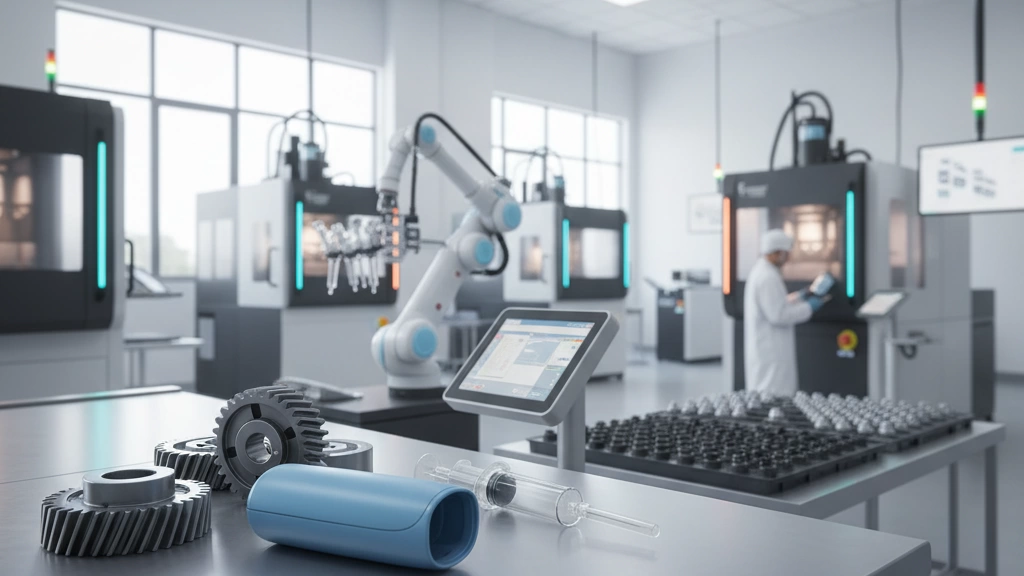
How Injection Moulding Works
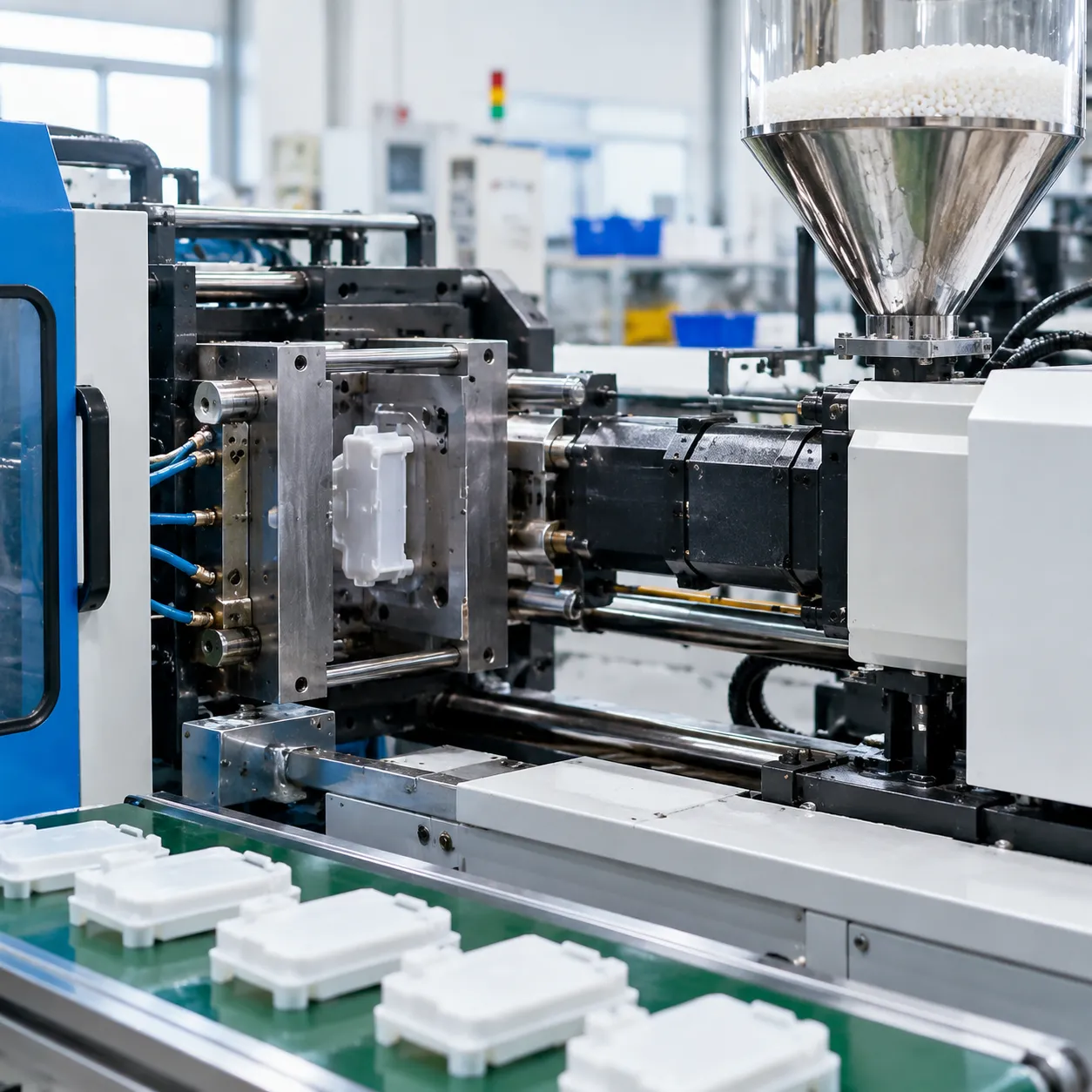
Injection moulding is a straightforward yet highly effective manufacturing process for producing plastic parts. It involves melting plastic pellets and injecting the molten material into a precision-made mold cavity under high pressure. Once cooled and solidified, the mold opens to release a fully formed part that matches the mold’s shape and details exactly.
This simple cycle is repeated rapidly, allowing manufacturers to produce thousands or even millions of identical parts with minimal variation. The key advantages of injection moulding become clear from this process:
- Fast production cycles enable high output rates.
- Consistent material flow delivers tight dimensional tolerances and repeatability.
- Precision molds produce complex geometries with excellent surface finishes.
- Efficiency in material use reduces waste and lowers costs at volume.
By combining speed, accuracy, and flexibility, injection moulding meets the demanding needs of high-volume plastic part production in industries ranging from automotive to medical devices.
Exceptional Production Speed & High Output Rate
One of the biggest advantages of injection moulding is its impressive production speed. Once the mold is ready, the process quickly injects molten plastic into the cavity, cools, and ejects the finished part—all in a matter of seconds to a few minutes per cycle. This fast cycle time means manufacturers can produce thousands or even millions of parts in a short period, making it ideal for high volume plastic manufacturing.
Because injection moulding runs continuously with minimal downtime, it delivers a consistent, high output rate that other methods like CNC machining or 3D printing can’t match. This efficiency lowers the per-part cost as production scales up, helping businesses meet tight deadlines and customer demand quickly.
If you’re interested in understanding how injection moulding works in detail or want to explore how it compares to other plastic manufacturing methods, check out this comprehensive guide on the benefits of plastic injection moulding.
Outstanding Repeatability and Tight Tolerances (±0.005 mm)
One of the biggest advantages of injection moulding is its ability to deliver outstanding repeatability. Once your mold is set up and optimized, it can produce thousands to millions of identical parts with very little variation. This consistent precision is essential for industries like automotive, medical devices, and electronics, where even the smallest deviation can lead to assembly issues or performance problems.
Injection moulding achieves tight tolerances as precise as ±0.005 mm, ensuring every part fits and functions exactly as designed. This level of accuracy is difficult to match with other plastic part production methods such as CNC machining or 3D printing when scaling up volumes. It’s why many companies trust injection moulding for complex, high-precision plastic components.
This reliability reduces the need for secondary operations like trimming or finishing, saving time and lowering costs. For more insight into how injection moulding controls quality, you can explore detailed guides on what is injection moulding and how the process maintains consistent output.
In short, if your project demands tight dimensional control and repeatable accuracy at high volume, injection moulding stands out as a top choice.
Lowest Cost per Part at High Volume (break-even vs CNC & 3D printing)
One of the biggest advantages of injection molding is its unmatched cost efficiency at high volumes. While CNC machining and 3D printing can be great for prototyping or low-volume runs, their per-part costs stay relatively high because each piece requires individual processing or printing time. Injection molding, on the other hand, uses a custom mold to produce thousands — even millions — of identical parts quickly, driving down the cost per part dramatically.
Although the initial investment for tooling can be significant, this cost is offset once you reach the break-even volume, which usually falls between a few thousand to tens of thousands of pieces. Beyond that point, injection molding becomes the clear winner for mass production, offering the lowest cost per unit compared to other plastic part production methods.
For manufacturers in the U.S. aiming for large-scale production without compromising quality or consistency, injection molding presents a highly economical solution. You can also benefit from options like hot-runner systems that reduce material waste and further cut costs.
If you're interested in exploring material choices that help optimize costs alongside performance, check out the range of plastics for injection moulding available to suit varying budget and design needs.
Almost Unlimited Material Selection (PP, ABS, PC, POM, PEEK, TPE, etc.)
One of the biggest advantages of injection moulding is the vast range of materials you can work with. Whether you need polypropylene (PP), acrylonitrile butadiene styrene (ABS), polycarbonate (PC), polyoxymethylene (POM), polyether ether ketone (PEEK), thermoplastic elastomers (TPE), or many other specialty plastics, injection moulding can handle it. This flexibility means you can choose the best material for your part’s strength, durability, chemical resistance, or flexibility needs without redesigning your process.
This broad material selection also supports advanced applications, from automotive parts requiring high heat resistance to medical-grade plastics that meet strict safety standards. With such options, you get tailored performance while maintaining cost-effectiveness in high volume plastic manufacturing. For more on material options and how they affect tooling, see our detailed guide on plastic injection mould tooling.
Superior Surface Finish Straight from the Mold
One big advantage of injection moulding is the quality of the surface finish you get right out of the mold. Whether you need a smooth, shiny SPI-A1 mirror finish or a textured look for grip or aesthetic reasons, injection moulding delivers consistent results without extra polishing or painting. This is great for products where appearance matters, like consumer electronics or automotive interiors.
The process supports a variety of surface textures, including proprietary finishes like PMI, so manufacturers can meet both functional and design needs easily. With injection moulding, you cut down on post-production work, saving time and cost while maintaining a professional look.
If you’re looking for precision with excellent surface quality, exploring precision plastic injection moulding options gives you access to the latest in mold surface technology and control.
Complex Geometry & Undercuts Made Easy
One major advantage of injection moulding is its ability to handle complex geometry and undercuts with ease. Unlike traditional manufacturing methods, injection moulding uses clever mechanisms like slides, lifters, and unscrewing molds that allow for intricate shapes and features that would otherwise be impossible or costly to produce. This flexibility lets designers create parts with built-in hinges, snap fits, threads, and deep recesses in a single molding process, reducing assembly steps and overall costs.
These advanced mold components move during the injection cycle, enabling the release of parts with undercuts or side holes without damaging the product or the mold. This is especially useful in industries such as automotive, electronics, and medical devices where precision and complexity are critical.
If you’re curious about how different plastics perform in these complex molds, you can check out our detailed guide on the materials used for injection moulding.
Minimal Material Waste with Injection Moulding
One major advantage of injection moulding is its ability to minimize material waste, making it a cost-effective and eco-friendly plastic part production method. Thanks to technologies like runner regrind and hot-runner systems, excess plastic that would normally be discarded can be recycled and reused. Runner regrind allows the plastic runners—the channels that guide molten plastic into the mold cavities—to be ground up and fed back into production without losing quality. Hot-runner systems take this further by keeping the plastic molten within the mold runners, eliminating solid runners altogether and reducing scrap from each cycle.
This low waste manufacturing process not only cuts material costs but also supports sustainability goals, which is increasingly important for U.S. manufacturers looking to reduce their environmental impact. Injection molding’s efficient material use often outperforms alternative production methods like CNC machining or 3D printing, where scrap rates are typically higher.
For more information on how this process benefits high volume plastic manufacturing with minimal waste, check out our detailed overview on advanced injection moulding technology.
Excellent Color Control & Consistency in Injection Moulding
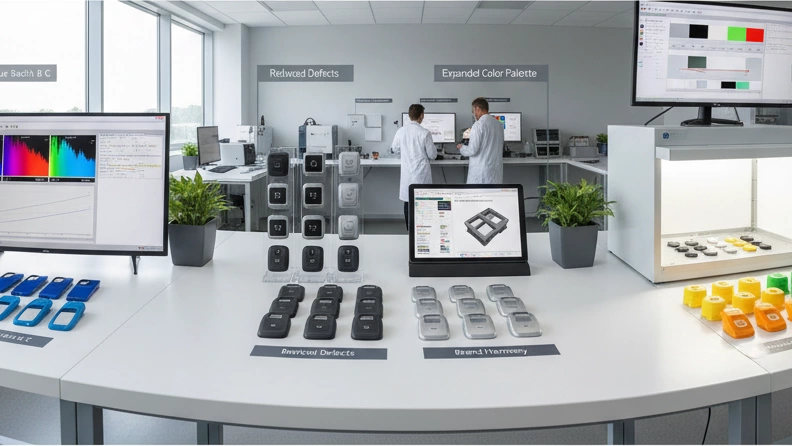
One of the standout advantages of injection moulding is its ability to deliver excellent color control and consistency across large production runs. Whether using masterbatch pellets, liquid coloring, or pre-colored compounds, injection moulding ensures that every part matches the exact color specifications. This is crucial for industries like consumer electronics and automotive interiors, where brand colors must remain uniform.
With precise dosing systems, manufacturers can consistently replicate shades and tones, minimizing color variations and waste. This level of control outperforms other plastic part production methods, making injection moulding a trusted choice for projects that demand reliable aesthetics.
For deeper insights into materials and color options, you can explore resources on plastic manufacturing processes that highlight the latest trends and best practices in injection moulding.
Ability to Mold Inserts, Overmolding & Multi-material Parts
One of the standout advantages of injection moulding is its ability to handle complex multi-material parts, including insert moulding and overmolding. This process lets manufacturers embed metal inserts, threaded components, or electronics directly into plastic parts during production, saving time and assembly costs. Overmolding allows two or more materials—often with different properties like hard plastic combined with soft TPE grips—to be molded together, creating functional and ergonomic designs in one seamless part.
This flexibility means you can combine materials for strength, aesthetics, or tactile feel without extra steps, improving product quality and durability. Insert and overmolding benefits are especially popular in automotive parts, consumer electronics, and medical devices where multi-material construction is essential.
For businesses looking to optimize product design and reduce post-production work, these advanced molding techniques present a significant advantage over traditional plastic part production methods. To explore more about precision molding options and customization, check out our comprehensive OEM & ODM manufacturing services.
High Strength & Structural Integrity with Injection Moulding
One major advantage of injection moulding is its ability to produce parts with excellent strength and structural integrity. This process allows for advanced techniques like gas-assist injection, foam injection, and fiber reinforcement, which significantly enhance the mechanical properties of plastic parts.
- Gas-assist injection uses pressurized gas to create hollow sections inside thick parts, reducing weight while maintaining rigidity.
- Foam injection incorporates gas bubbles into the plastic, improving impact resistance and reducing material usage without compromising strength.
- Fiber reinforcement, such as glass or carbon fibers, can be added to the resin blend to boost stiffness, tensile strength, and durability, ideal for automotive and industrial components.
These methods ensure your injection moulded parts can withstand high stress and demanding conditions, making them reliable for products that require structural performance. For example, reinforced parts are common in automotive injection moulding and medical-grade applications, where safety and durability are critical.
By choosing an experienced injection moulding partner, you can access these advanced reinforcement options to meet your product’s specific strength requirements efficiently. For more on how these capabilities support strict industry standards and performance, check out our detailed whitepapers on injection moulding technologies.
Scalability – From 100 to 10 Million+ Parts Without Major Re-Tooling
One of the biggest advantages of injection moulding is how easily it scales. Whether you need just a few hundred parts or millions, injection moulding lines up perfectly. Once the mold is made, it can produce consistent parts over large runs without needing constant changes. This means you don’t have to worry about investing in new tools or setups every time your order size grows.
For U.S. manufacturers, this scalability is key. You can start small with rapid tooling or aluminum molds to test designs, then ramp up production using hardened steel molds designed for millions of cycles. The process stays reliable, cost-effective, and efficient at any volume—something you rarely get with CNC machining or 3D printing.
This flexibility saves both time and money, making injection moulding the go-to choice for businesses planning to scale production from prototypes to full-scale manufacturing runs.
Automation-Friendly = Lower Labor Costs in 2025
One big advantage of injection moulding is how easy it is to automate. In today’s manufacturing landscape, especially in the U.S., automation means cutting labor costs without sacrificing quality. Injection moulding machines can run with minimal human intervention, using robots for part removal, assembly, and quality checks. This helps keep production fast and consistent while reducing errors.
Here’s why automation in injection moulding stands out:
- Faster cycle times thanks to precise machine control
- Ability to run 24/7 shifts without fatigue or quality loss
- Lower chances of human error, improving overall yield
- Reduced workforce needs, which lowers labor expenses
- Easier integration with Industry 4.0 systems for real-time monitoring and process optimization
As labor costs continue to rise in the U.S., choosing injection moulding with automation-friendly capabilities is smart. It keeps prices competitive when producing high volumes and supports sustainable, efficient manufacturing for 2025 and beyond.
Compliance with Strict Industry Standards (ISO 13485, IATF 16949, FDA, RoHS)
One of the top advantages of injection moulding is its ability to meet strict industry standards, making it the go-to choice for regulated markets in the U.S. Whether you’re in medical, automotive, or consumer products, injection moulding can comply with certifications like ISO 13485 for medical devices, IATF 16949 for automotive quality, FDA regulations for food and health safety, and RoHS for hazardous substances.
This compliance ensures your parts aren’t just high-quality but also legally ready for market. Injection moulding processes can be tightly controlled and validated to meet these standards, which is critical for industries where safety and reliability aren’t optional. Plus, many injection molding facilities in the U.S. maintain cleanrooms and follow strict documentation protocols, helping manufacturers pass audits easily.
If you need plastic part production methods that align with tough regulations, injection moulding stands out by offering both consistency and peace of mind—key for scaling up production while staying compliant.
Design Flexibility with Rapid Prototyping Support
One major advantage of injection moulding is its impressive design flexibility backed by rapid prototyping options. Using aluminum molds and bridge tooling, manufacturers can quickly develop and test parts before committing to expensive steel tooling. This approach allows for faster design iterations, ensuring your product meets exact specifications without costly delays.
Rapid prototyping with injection moulding helps bring ideas to life fast, making it easier to tweak complex geometries or add features like undercuts and inserts. Plus, it supports a smoother transition to mass production with minimal re-tooling. For U.S. businesses seeking efficient plastic part production methods, this flexibility is a game-changer.
If you’re exploring different stages of product development, consider looking into rapid tooling injection moulding to accelerate your prototype to production timeline without sacrificing quality.
Sustainable Options for Injection Moulding
Injection moulding is stepping up in sustainability, making it a smart choice for eco-conscious manufacturing. Here’s how it supports greener production:
- Bio-Based Resins: Use of plant-based plastics like PLA or bio-PP reduces reliance on fossil fuels.
- Closed-Loop Recycling: Runner systems and scrap material are collected, reprocessed, and reused with minimal waste.
- Reduced Energy Use: Modern machines with energy-efficient motors lower power consumption during production.
- Longer Part Life: Tough, durable parts reduce replacements and waste over time.
- Sustainable Packaging: Injection moulding supports creating recyclable or biodegradable packaging components.
| Feature | Benefit |
|---|---|
| Bio-Based Resins | Lower carbon footprint |
| Closed-Loop Recycling | Almost zero material waste |
| Energy-Efficient Tech | Cuts production energy cost |
| Durable Parts | Less frequent replacements |
| Recyclable Parts | Easier end-of-life disposal |
By integrating these options, injection moulding complies with rising US market demands for environmentally friendly manufacturing — a definite advantage for companies aiming to meet sustainability goals without sacrificing quality or cost-efficiency.
Real-World Case Studies: Consumer Electronics (Phone Cases)
Injection moulding is a top choice for making phone cases because it combines speed, precision, and flexibility. Manufacturers can produce millions of high-quality cases with consistent tight tolerances and vibrant color options, crucial for consumer appeal. Materials like TPU, PC, and ABS are commonly used, giving phone cases durability, impact resistance, and a great surface finish right out of the mold.
With injection moulding, complex designs featuring textured grips, logos, or even overmolded soft-touch layers are easy to produce at scale. This process also supports rapid iterations for new styles or custom designs without significant extra costs. For U.S. brands, injection moulding helps keep costs low while meeting strict quality standards and fast delivery demands, making it an ideal solution for the competitive consumer electronics market.
Real-World Case Study: Automotive Interior Parts
Injection moulding is a go-to choice for automotive interior parts because it delivers high precision, consistent quality, and strong structural integrity. Parts like dashboard components, air vents, door panels, and trim pieces are often made with injection moulding due to its ability to handle complex geometry and tight tolerances—critical for fit and finish in vehicle cabins.
Here’s why injection moulding works so well in automotive interiors:
- High volume production: Automakers need millions of identical parts, which injection moulding can produce efficiently with low cost per part.
- Material variety: From ABS to reinforced plastics, the wide material choices allow parts to meet flame retardant, UV resistance, and durability standards.
- Surface finish options: Whether smooth, textured, or gloss, injection moulding achieves consistent surface styles that match brand aesthetics.
- Weight reduction: Lightweight materials and structural designs help meet auto industry fuel efficiency and emissions goals.
- Insert moulding: Metal inserts for screws or clips can be molded into plastic parts, improving assembly speed and durability.
- Automated production lines: Injection moulding easily integrates with robotics, enabling fast, reliable manufacturing with reduced labor costs.
In U.S. automotive manufacturing, injection moulding plays a key role in creating quality interior parts that look good, last long, and meet strict industry standards like IATF 16949. This makes it the smart choice for OEMs and suppliers focusing on both performance and cost efficiency.
Real-World Case Studies: Medical Disposable Devices
Injection moulding plays a huge role in the medical field, especially for disposable devices. Think about things like syringes, test tubes, inhalers, and surgical components. These parts need to be ultra-precise, sterile, and strong but cost-effective because they’re used once and tossed.
The biggest advantage here is injection moulding’s repeatability and tight tolerances — you get consistent quality in every batch. Plus, medical-grade plastics (like PC, PEEK, and medical-grade PP) can be used to meet strict FDA and ISO 13485 standards.
These devices often have complex shapes and fine details, which injection moulding can handle with ease. It also supports overmolding and insert moulding, enabling parts with multiple materials or embedded components — crucial for advanced medical tools.
Lastly, the process generates minimal waste and supports sterile manufacturing environments, making it perfect for disposable medical products where safety and hygiene can’t be compromised. This cuts costs while delivering reliable parts in huge volumes, which hospitals and clinics rely on every day.
When Injection Moulding Is NOT the Best Choice
Injection moulding is great for many projects, but there are times it’s not the best fit. Here’s when you might want to consider other plastic part production methods:
- Low Volume Production (<500 pcs): The upfront tooling costs for injection moulding can be high. If you’re only making a small batch, the cost per part can skyrocket compared to CNC machining or 3D printing.
- Very Large Parts: Injection moulding machines have size limits. Big, bulky parts might not fit or require costly, oversized molds, making other processes like blow molding or CNC machining a better option.
- Constant Design Changes: Injection moulding tooling is expensive and time-consuming to adjust. If your product design keeps changing, rapid prototyping or 3D printing give you more flexibility and faster turnaround.
In , if your project falls into these categories—low volume, oversized parts, or frequent design tweaks—it’s worth exploring alternative manufacturing methods to save time and money.
Cost Breakdown: Tooling vs. Piece Price in 2025 and Tooling Cost Recovery
When considering the advantage of injection moulding, understanding the cost breakdown is crucial. In 2025, the biggest upfront expense is still the tooling—the mold itself. Tooling can range from a few thousand dollars for simple aluminum molds to tens of thousands for complex steel molds designed for high-volume production. This initial investment covers the precise machining and engineering needed to produce parts with tight tolerance plastic parts consistently.
However, once the tooling is in place, the cost per piece drops significantly, especially compared to other plastic part production methods like CNC machining or 3D printing. Injection moulding reaches its breakeven point quickly—often after producing just a few hundred to a few thousand parts—making it the most cost-effective choice for high volume plastic manufacturing.
Key points on tooling vs. piece price:
- Tooling Cost: High upfront, but amortized over the run
- Piece Price: Very low per unit when volumes scale beyond a few thousand
- Break-even Volume: Depends on design complexity, but often under 5,000 parts
- Cost Recovery: Tooling costs recover quickly in large productions, reducing overall project expenses
- Material Savings: Minimal waste and regrind reuse lower ongoing costs
- Automation: Further reduces labor costs, improving profitability
For U.S. manufacturers looking to scale, investing wisely in tooling is key. The faster you amortize the mold cost, the lower your injection moulding cost per part becomes—ideal for automotive injection moulding, medical grade injection moulding, and other industries needing consistent, tight tolerance plastic parts.
Latest Technology Trends in Injection Moulding
Injection moulding is evolving fast with new tech driving efficiency and quality. Here’s a quick look at the latest trends shaping the industry in the U.S.:
- Industry 4.0 and Smart Molds: Connected, data-driven systems now let manufacturers monitor mold conditions, cycle times, and part quality in real time. This means fewer defects, less downtime, and faster problem-solving.
- Conformal Cooling: Advanced cooling channels built directly inside molds improve heat transfer. Faster and more uniform cooling reduces cycle times and warping, giving tighter tolerances and better surface finishes.
- LSR & Silicone Injection: Liquid Silicone Rubber (LSR) injection is growing for flexible, durable parts like seals and medical devices. It offers superior heat resistance and extreme flexibility compared to regular plastics.
- MuCell Foaming Technology: This innovative foaming process injects gas bubbles into the plastic, reducing weight and material use without sacrificing strength. It’s a great option for automotive parts where weight savings are critical.
These tech trends keep injection moulding ahead in speed, sustainability, and precision—helping American manufacturers meet tight production schedules and quality demands.
How to Choose a Reliable Injection Moulding Partner: 10-Point Checklist
Picking the right injection moulding partner is key to your product’s success. Here’s a simple checklist to help you find a reliable supplier that fits your needs in the U.S. market:
| Checklist Item | Why It Matters |
|---|---|
| 1. Design for Manufacturability (DFM) Support | Ensures your design is optimized for injection moulding, saving time and cost. |
| 2. In-House Toolroom | Faster tooling turnaround and better quality control. |
| 3. Cleanroom Facilities | Must-have if you’re in medical, food, or sensitive tech sectors. |
| 4. Material Expertise | Wide material choices including PP, ABS, PEEK, or specialty resins. |
| 5. Quality Certifications | Compliance with ISO 13485, IATF 16949, FDA, RoHS signals reliability. |
| 6. Production Capacity | Can they scale from prototypes to millions of parts with ease? |
| 7. Automation & Technology | Modern equipment (Industry 4.0, smart molds) drives efficiency and reduces defects. |
| 8. Cost Transparency | Clear breakdown of tooling and per-part costs helps budget planning. |
| 9. Sustainability Practices | Commitment to recycling, bio-based resins, and minimal waste fits U.S. market demand. |
| 10. Strong Communication | Responsive and clear updates keep your project on track. |
 English
 French
 German
 Spanish
 Italian
 Polish
 Russian
 Japanese
 Korean
 Arabic
 Dutch
 Portuguese
 Swedish
 Norwegian
 Belarusian
 Armenian