
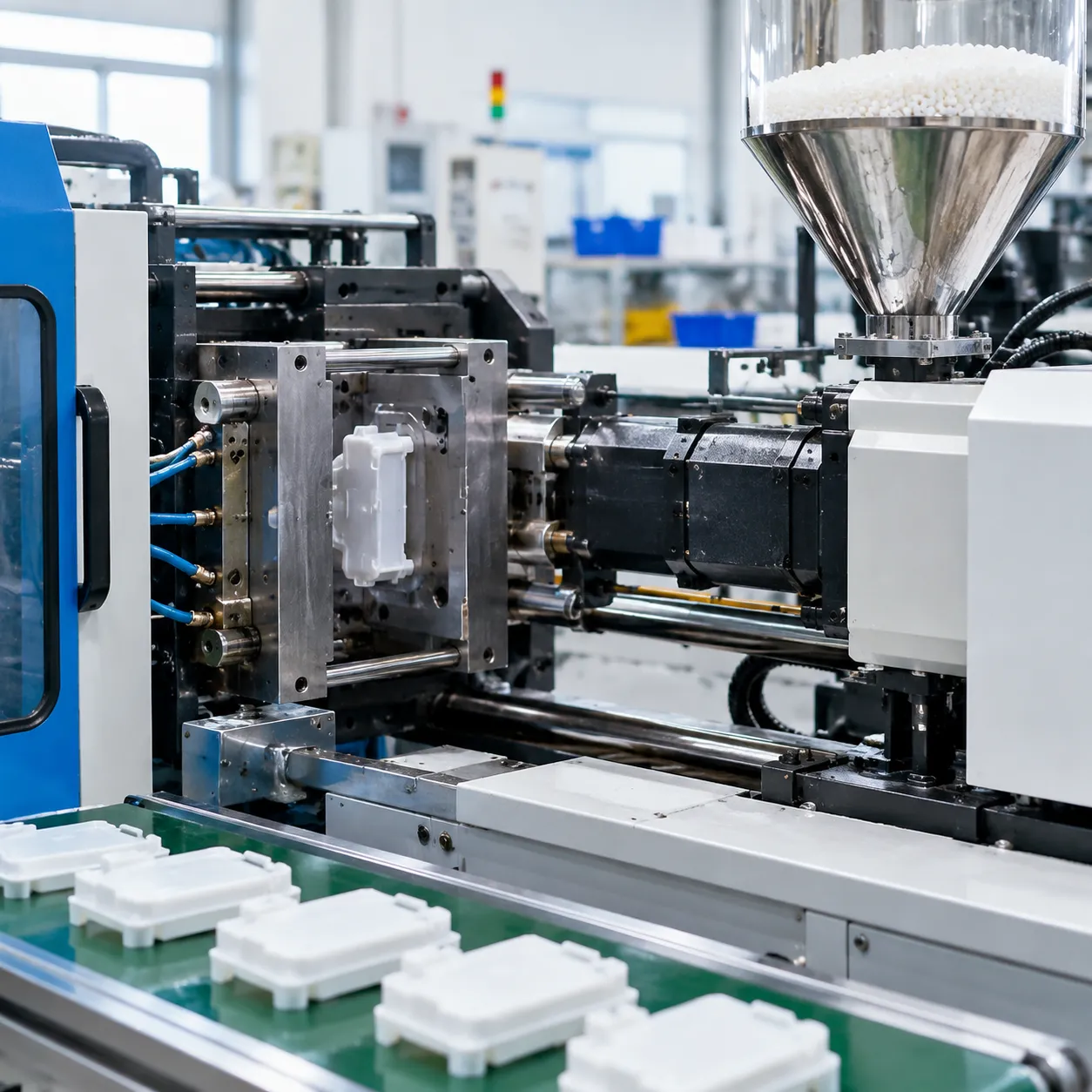
What Makes SAN Resin Unique for Injection Moulding?
As an injection molding manufacturer running clear plastics daily, we rely on SAN (Styrene Acrylonitrile) when standard transparent resins fall short. SAN bridges the gap between brittle polystyrene and expensive specialty polymers, delivering rigid, crystal-clear parts with enhanced chemical and thermal durability right out of the press.
Chemical Makeup: Balancing Styrene Clarity with Acrylonitrile Toughness
SAN is a rigid, transparent copolymer engineered by copolymerizing styrene and acrylonitrile:
- Styrene content (70–80%): Provides optical brilliance, a high refractive index, and excellent melt flow during the injection phase.
- Acrylonitrile content (20–30%): Adds polar bonds that deliver surface hardness, impact toughness, heat resistance, and environmental stress cracking (ESC) resistance.
This molecular pairing prevents the brittle failure common in general-purpose polystyrene (GPPS) while maintaining predictable shrinkage and cycle times on the shop floor.
Key Mechanical and Optical Properties
SAN resin delivers a balance of stiffness, aesthetic clarity, and dimensional stability for high-precision components:
| Eigenschaft | Typical Value Range | Shop-Floor Impact |
|---|---|---|
| Light Transmittance | 87% – 90% | Near-acrylic clarity for lenses, covers, and containers |
| Zugfestigkeit | 65 – 85 MPa | Resists deformation under sustained structural loads |
| Biegefestigkeit | 3,400 – 4,000 MPa | Outstanding part rigidity with minimal wall deflection |
| Rockwell Hardness (M) | M75 – M85 | Superior scratch resistance compared to GPPS and PC |
| Refractive Index | 1.56 – 1.57 | High-depth visual clarity with zero haze |
Thermal Stability and Heat Deflection Temperature (HDT)
SAN performs exceptionally well under continuous heat exposure compared to basic transparent resins:
- Heat Deflection Temperature (HDT): SAN exhibits an HDT range of 85°C to 105°C (185°F to 221°F) at 0.45 MPa, and 80°C to 98°C (176°F to 208°F) under a heavy 1.8 MPa load.
- Continuous service limits: Molded components hold structural dimensions up to 75°C–85°C without warping or sagging.
- Dishwasher and thermal shock resistance: The elevated HDT makes SAN fully capable of withstanding repetitive hot-water wash cycles and thermal spikes without optical distortion or micro-crazing.
Chemical Resistance Against Oils, Greases, and Harsh Detergents
Where standard clear thermoplastics fail through rapid crazing and stress cracking, SAN excels due to its bonded acrylonitrile network:
- Fats and edible oils: Impervious to cooking oils, butter, and animal fats, preventing cloudy surface degradation.
- Household detergents and cleaners: Resists surface etching from industrial dishwashing surfactants, window cleaners, and mild alcohols.
- Hydrocarbons and chemicals: Stable against aliphatic hydrocarbons, battery acids, bleach, and non-aromatic lubricants.
- Stress-crack prevention: Significantly higher critical strain limits than acrylic (PMMA) or GPPS when exposed to solvent-bearing reagents under tension.
Key SAN Injection Moulding Process Parameters
Dialing in the right process window for styrene acrylonitrile injection molding makes the difference between a cloudy, brittle reject and a crystal-clear part. As an experienced team on the shop floor, we treat SAN with the care a rigid, transparent thermoplastic demands. Balancing melt fluidity with packing pressure ensures parts release cleanly with zero internal haze or sink marks. Knowing the core Vorteil und Nachteil des Spritzgießens clear polymers helps us optimize cycle times without sacrificing optical performance.
Drying SAN Pellets: Moisture Control
SAN is moderately hygroscopic and will soak up ambient moisture quickly. Processing wet resin leads straight to silver splay, internal micro-voids, and cosmetic blemishes.
- Trocken-Temperatur: 75°C to 85°C (167°F to 185°F).
- Trocknungszeit: 2 to 4 hours in a desiccant dryer.
- Target Dew Point: -40°C (-40°F) or lower.
- Ziel-Feuchtigkeitsgehalt: Below 0.05% before charging the barrel.
- Shop Tip: Never let dried pellets sit in an open hopper for more than 15 minutes; use sealed loaders whenever possible.
Melt Temperature and Barrel Zone Profiles
SAN resin does not tolerate long residence times at extreme heat. If the barrel runs too hot, the material yellows; run it too cold, and un-melted shear marks will ruin the transparency. A gradual progressive profile works best:
| Barrel Section | Recommended Temperature |
|---|---|
| Feed Zone (Rear) | 190°C – 210°C (374°F – 410°F) |
| Mittlere Zone | 210°C – 230°C (410°F – 446°F) |
| Metering Zone (Front) | 225°C – 245°C (437°F – 473°F) |
| Düse | 220°C – 240°C (428°F – 464°F) |
| Actual Melt Temperature | 220°C – 250°C (428°F – 482°F) |
Mold Temperature Settings for Surface Gloss
Clear plastics need warm cavity walls to duplicate the polished surface finish of the tool.
- Recommended Mold Temperature: 50°C to 80°C (122°F to 176°F).
- High-Gloss Finish: Run the tool around 70°C to 80°C. Warmer tools slow down skin freeze, boosting surface gloss and minimizing weld lines.
- Stress Management: Running below 40°C introduces high residual stress, which causes part cracking when the component encounters cleaners or secondary solvents later.
Injection Pressure, Holding Pressure, and Packing Times
Because SAN has relatively high viscosity, pressure management is critical:
- Einspritzdruck: Typically set between 80 to 140 MPa (800 – 1400 bar).
- Haltdruck: Set to roughly 50% to 70% of peak injection pressure.
- Packing Strategy: Step down the holding pressure gradually to prevent gate freeze stress while eliminating sink marks on thicker ribs.
- Gate Seal Time: Determine seal time with part-weighing tests; hold pressure until the gate freezes completely to avoid backflow voids.
Injection Speed and Screw Recovery Guidelines
- Injektionsgeschwindigkeit: Moderate to slow. Extremely fast injection generates shear heat, causing gate blush and jetting. A profiled injection speed (slow through the gate, moderate through the cavity, slow near end of fill) gives the cleanest optical result.
- Screw Speed (RPM): 40 to 70 RPM. Avoid fast rotation to prevent thermal degradation of the polymer chains.
- Back Pressure: 5 to 15 MPa (50 to 150 bar). A moderate back pressure ensures thorough melting and removes entrapped air without generating excessive shear heat.
- Cushion: Maintain a stable 3 mm to 6 mm cushion to ensure reliable pressure transfer during the pack-and-hold phase.
Part Design Guidelines for SAN Injection Moulding
Designing parts for styrene acrylonitrile injection molding requires balancing optical clarity with mechanical stiffness. Because SAN is an amorphous, notch-sensitive material with low shrinkage, tooling design must account for internal stress, mold release, and tight venting. Weighing these geometry limits is a key step in evaluating the Vorteil und Nachteil des Spritzgießens transparent components.
Ideal Wall Thickness and Handling Transitions
We aim for consistent, uniform nominal wall thicknesses across the entire part to eliminate differential cooling, which creates hazing, internal stress, and optical distortion.
- Recommended Wall Range: 1.5 mm to 3.5 mm (0.060" to 0.140"). Thin walls under 1.2 mm risk short shots and excessive shear stress, while walls over 4.0 mm easily develop internal vacuum voids and sink marks.
- Wall Transitions: When wall thickness steps are unavoidable, we use gradual transition ramps (a 3:1 taper) rather than abrupt steps. Keep thickness changes within 25% of adjacent walls to ensure uniform melt front velocity and reduce optical distortion lines.
Draft Angles and Corner Radii
Because SAN exhibits low shrinkage (typically 0.2% to 0.6%) and high rigidity, parts cling aggressively to mold cores. Inadequate draft leads to drag marks, micro-cracks, and ejection stress whitening.
| Eigenschaft | Minimum Specification | Recommended Practice |
|---|---|---|
| Draft Angle (Polished Core/Cavity) | 1.0° to 1.5° per side | 2.0° per side for flawless cosmetic surfaces |
| Draft Angle (Textured Surfaces) | 1.5° per 0.025 mm texture depth | Add 1° of draft per each 0.02 mm of etch |
| Internal Corner Radii (R) | 0.5 × Wall Thickness | Never use sharp corners; sharp radii trigger stress cracking |
| External Corner Radii | 1.5 × Wall Thickness | Eliminates stress concentration at the edges |
We maintain corner radii of at least 0.5 times the wall thickness. Sharp internal corners concentrate stress and severely compromise SAN’s impact resistance.
Gate Selection and Placement
Proper gate choice preserves clarity, reduces flow lines, and prevents high-shear blush near the entrance:
- Edge and Tab Gates: Our primary choice for flat panels, cosmetic covers, and display lenses. They allow generous land areas to keep melt shear low, eliminating gate blush and splay.
- Fan Gates: Essential for wide, flat parts. Fan gates disperse the melt front evenly, preventing jetting and reducing cosmetic weld lines across visible sightlines.
- Sub-Gates (Tunnel Gates): Usable for automated production, but gate diameters must stay above 1.2 mm. Undersized sub-gates introduce shear-induced yellowing and localized stress.
- Heißkanal-Systeme: Valve gates provide the cleanest cosmetic results. Direct thermal sprue gates often cause localized drooling and gate vestige cracking.
- Gate Location Rules: Always gate into the thickest wall section and let the melt flow toward the thinner walls. Avoid gating directly in high-stress impact zones or optically critical windows.
Optimal Venting Depth
Poor venting turns trapped air into diesel burns, cloudy haze, and weak knit lines. Because SAN has moderate melt viscosity, vents must be cut precisely to purge air without flashing:
- Vent Land Depth: 0.025 mm to 0.035 mm (0.0010" to 0.0014"). Depths over 0.040 mm will produce flash on warm tools.
- Vent Land Length: Keep the land short at 1.0 mm to 1.5 mm, opening immediately into a 0.8 mm to 1.0 mm deep relief channel leading out to the atmosphere.
- Platzierung: Vent along the parting line at the absolute last point of fill, as well as along ejector pins and core inserts where air pockets naturally congregate.
Troubleshooting Common SAN Injection Moulding Defects
Because styrene acrylonitrile is transparent and rigid, every internal flaw shows up immediately. When running SAN injection moulding jobs, visual defects ruin both cosmetic appeal and structural integrity. We rely on targeted Defekten im Spritzgießen zu identifizieren und deren Fehlersuche methods to correct issues quickly on the shop floor.
Eliminating Moisture Streaks and Silver Splay
Moisture splay appears as silver streaks, clouds, or micro-bubbles fanning out along the flow path. SAN resin is naturally hygroscopic and absorbs ambient humidity rapidly.
- Dry thoroughly: Dry pellets at 75°C to 85°C (167°F–185°F) for 2 to 4 hours using a desiccant dryer with a dew point of -40°C or lower.
- Check moisture targets: Ensure the moisture content drops below 0.05% before resin enters the feed throat.
- Check barrel decomp (suck-back): Avoid excessive suck-back distances, which draw air past the nozzle tip and mimic moisture splay.
Minimizing Weld Lines and Knit Lines in Clear Components
Weld lines form where two melt fronts split around a core pin and meet downstream. In clear plastic injection molding, these show up as sharp optical seams and structural weak points.
- Raise mold temperatures: Increase tool temperature to 60°C–80°C so the melt fronts stay fluid enough to knit properly.
- Increase injection speed: Fill faster during flow convergence to prevent premature skin freezing at the meeting point.
- Add venting at knit points: Cut 0.02 mm–0.03 mm vents right where the fronts collide to prevent trapped air pockets.
- Relocate gates: Move gate positions during tool design so knit lines fall into non-visible or low-stress regions.
Preventing Sink Marks and Vacuum Voids in Thicker Walls
SAN has a mold shrinkage rate between 0.4% and 0.7%. Thick wall sections (like luxury cosmetic caps or heavy handles) can develop surface sinks or internal vacuum bubbles if packing is insufficient.
- Increase hold pressure and pack time: Keep the screw forward until the gate freezes completely to pack out volumetric shrinkage.
- Open up gate dimensions: Enlarge gate lands and runners so the gate does not freeze off before the thick walls pack out.
- Niedrigere Schmelztemperatur: Run barrel zones on the lower end of the processing window (210°C–230°C) to reduce total volumetric contraction.
Managing Residual Stress, Part Warpage, and Crazing
SAN's rigid polymer chains make it vulnerable to molded-in stress. High residual stress causes parts to warp, show birefringence under polarized light, or crack (craze) when exposed to chemicals.
- Balance mold cooling: Ensure core and cavity temperatures match closely. Uneven cooling pulls the part and induces warp.
- Avoid over-packing near the gate: Step down holding pressure toward the end of the packing phase to avoid localized stress peaks.
- Anneal critical components: For parts requiring maximum chemical resistance, anneal in an oven at 65°C to 75°C for 2 hours to relieve internal strain.
Fixing Jetting and Surface Blush Near the Gate
Jetting happens when resin squirts through an undersized gate like a thin rope without expanding against cavity walls. Blush appears as a dull, cloudy ring around the gate caused by shear stress.
- Profile injection speeds: Start with a slow fill speed until the melt clears the gate, then ramp up to fill the main cavity.
- Modify gate geometry: Transition to fan, edge, or submarine gates directed against a cavity wall or pin to break up the jet stream.
- Verify cold slug wells: Enlarge cold slug wells opposite the sprue and runners to capture cold material before it enters the part cavity.
| Fehler | Primary Root Cause | Fast Shop-Floor Fix |
|---|---|---|
| Silver Splay | Trapped moisture or air in melt | Dry material to <0.05% moisture; decrease screw suck-back. |
| Visible Knit Lines | Cold melt fronts failing to fuse | Raise tool temperature by 5°C–10°C; increase injection speed. |
| Sink Marks / Voids | Gate freeze-off before pack completion | Enlarge gate thickness; lengthen hold time and boost hold pressure. |
| Crazing & Cracking | High molded-in stress at gate | Reduce high packing pressures; increase mold wall temperatures. |
| Gate Blush / Jetting | Excessive shear or free resin squirt | Slow down initial injection velocity; increase gate land radius. |
SAN vs Other Clear Resins in Injection Moulding
Choosing the right resin for clear plastic injection molding comes down to balancing part clarity, chemical resilience, and tooling cycle efficiency. While several transparent polymers look identical on the shelf, their processing behavior and field performance vary drastically. As a professional injection molding manufacturer and supplier, we regularly guide clients through material trade-offs to hit performance targets without inflating production budgets.
| Property / Feature | SAN (Styrol-Acrylonitril) | GPPS (General Purpose Polystyrene) | PMMA (Acrylglas) | PC (Polycarbonat) |
|---|---|---|---|---|
| Optical Transmission | ~87% – 90% | ~88% – 90% | ~92% (Highest) | ~88% – 89% |
| Schlagfestigkeit | Mäßig | Very Low / Brittle | Niedrig bis Moderat | Außerordentlich hoch |
| Chemikalienbeständigkeit | High (fats, oils, detergents) | Schlecht | Mäßig | Poor (solvents, alkaline) |
| Scratch Resistance | Mäßig | Niedrig | Hoch | Low (requires coating) |
| Melt Flow & Processing | High stability, fast cycles | Fast cycles, easy flow | Stiffer melt, longer pack | High temp, high pressure |
| Relative Materialkosten | Mäßig | Niedrig | Mittel bis Hoch | Hoch |
SAN vs GPPS: Strength and Chemical Resistance vs Material Cost
GPPS is the baseline for budget-friendly clear mouldings, but it fractures under light mechanical loads and degrades quickly around household oils or cleansers. In SAN vs GPPS polystyrene evaluations:
- Mechanical durability: The acrylonitrile component in SAN elevates tensile strength and surface hardness, preventing the spiderweb cracking common in GPPS.
- Chemical exposure: SAN easily handles greasy food products, cosmetics, and industrial detergents that turn GPPS cloudy or brittle.
- Economics: While GPPS offers a lower upfront raw resin price, SAN significantly cuts warranty and drop-test failures in durable goods.
SAN vs PMMA: Impact Tolerance vs Optical Transparency and Scratch Resistance
In the debate of SAN vs PMMA acrylic, the choice hinges on whether your product demands ultra-pure optical transmission or structural resilience:
- Clarity and hardness: PMMA remains the gold standard for optical clarity injection moulding and scratch resistance, making it ideal for precision display panels and luxury cosmetic lenses.
- Toughness and flex: PMMA is inherently notch-sensitive and snaps easily under sudden shock. SAN absorbs impact shock far better without shattering.
- Moulding window: SAN flows with less shear sensitivity and solidifies faster, allowing shorter cooling times and fewer optical knit lines than PMMA.
SAN vs Polycarbonate: Processability and Cost-Efficiency vs Extreme Impact Strength
Polycarbonate delivers virtually unbreakable structural strength, but that toughness comes with severe manufacturing and financial trade-offs:
- Energy and cycle efficiency: PC requires high melt temperatures (often exceeding 300°C) and extreme injection pressures, which drives up equipment wear and cycle times. SAN processes at considerably lower barrel temperatures, trimming cycle seconds off high-volume production runs.
- Stress cracking: PC suffers from catastrophic environmental stress cracking when exposed to common industrial greases, aromatic hydrocarbons, or aggressive cleaners. SAN displays superior solvent and grease resistance under load.
- Bottom-line economy: Specifying PC when extreme impact resistance is not required unnecessarily raises your overall Kosten für Spritzguss. SAN provides the structural stiffness, visual depth, and gloss needed for premium housings at a fraction of the part cost.
Top Industrial Applications of SAN Injection Moulding
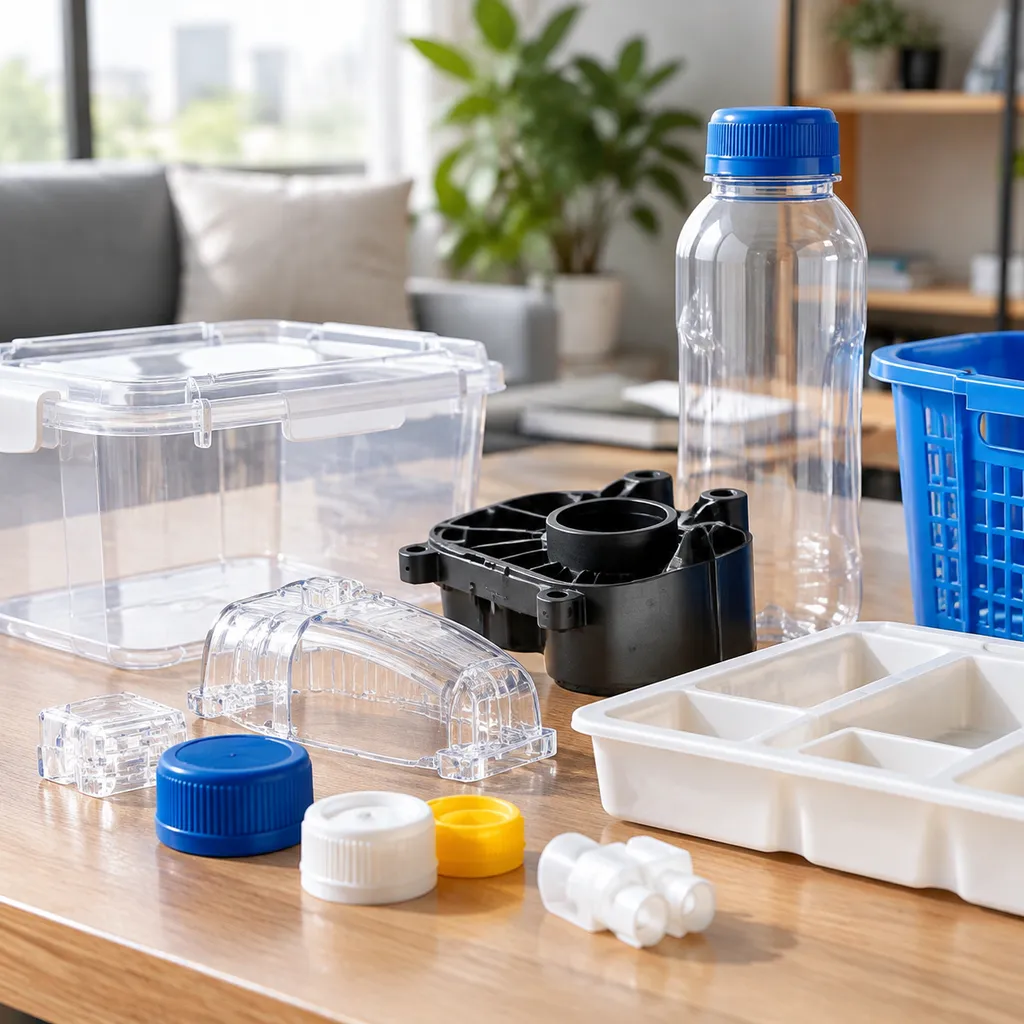
On our shop floor, SAN injection moulding consistently bridges the gap between low-cost basic polystyrene and expensive engineering polymers like acrylic or polycarbonate. When a product demands crystal clarity, solid dimensional stability, and resistance to everyday chemicals or fats, SAN resin is our go-to material. We run millions of SAN parts annually across four core industries where visual presentation and mechanical stiffness must go hand in hand.
Housewares and Food Storage Containers
SAN is an industry standard for premium kitchenware. Unlike standard GPPS, it withstands repeated dishwasher cycles, boiling hot liquids, and acidic food exposure without turning cloudy or crazing under thermal stress.
- Blender and Food Processor Jugs: Provides glass-like transparency while resisting blade vibration, motor torque, and cooking oils.
- Airtight Food Storage Canisters: Maintains strict dimensional tolerances to ensure hermetic silicone gasket seals fit tightly over years of use.
- Refrigerator Shelving and Crisper Drawers: Offers high structural rigidity without sagging under heavy loads at low operating temperatures.
- Tumblers and Pitchers: Resists staining from citrus juices, coffee, and aggressive alkaline detergents.
Cosmetic Packaging and Luxury Thick-Wall Bottles
In beauty packaging, weight and visual depth equal perceived luxury. SAN allows us to mold heavy, glass-imitating components without the high breakage rates or shipping weight penalties of real glass.
- Heavy-Base Jars and Caps: We utilize extended packing phases during clear plastic injection molding to produce crystal-clear wall sections exceeding 6 mm without sinks or voids.
- Lipstick Cases and Compact Mirrors: Takes metallic hot stamping, vacuum metallization, and silk screening exceptionally well while maintaining structural stiffness.
- Fragrance Outer Caps: Resists the alcohol, essential oils, and volatile aromatic compounds found in fine perfumes that would quickly crack standard acrylics.
Automotive Interior Lenses, Dials, and Battery Housings
Automotive cabins require materials that handle solar heat buildup, UV exposure, and cabin cleaner chemicals without yellowing or warping out of specification.
| Automotive Component | Key Performance Requirement | Why SAN Delivers |
|---|---|---|
| Instrument Cluster Lenses | High light transmission, anti-glare scratch resistance | High surface hardness (Rockwell M 80–85) prevents wipe scratches |
| HVAC Control Dials & Knobs | Tactile rigidity, precise snap-fits | Low mold shrinkage ensures tight tolerances on push-pull tabs |
| Industrial Battery Cases | Acid and electrolyte resistance | Acrylonitrile content prevents chemical attack and stress cracking |
| Audio Display Panels | Distortion-free optical clarity | Low birefringence maintains uniform backlighting distribution |
Diagnostic Medical Devices and Labware
In clinical and analytical settings, SAN provides an economical alternative to specialized copolyesters and fluoropolymers for non-implantable components. Through dedicated cleanroom manufacturing and specialized medizinisches Spritzgießen protocols, we run high-cavitation tools that deliver precise fluid-path components.
- Cuvettes and Pipette Trays: Flat, distortion-free optical windows ensure accurate light transmission readings during spectrophotometer analysis.
- Centrifuge Tubing Racks and Cassettes: High tensile modulus prevents flexing during high-speed handling and automated robotic tray pick-up.
- Dialysis Connector Housings and Filter Casings: Resists lipids, saline solutions, and blood components while remaining transparent enough for technicians to visually detect air bubbles or fluid clogs.
- Diagnostic Test Cartridges: Excellent flowability fills micro-fluidic channels cleanly while maintaining tight part-to-part consistency across high-volume runs.
FAQs About SAN Injection Moulding
Does SAN resin always require pre-drying before moulding?
Yes. SAN is a hygroscopic copolymer that readily absorbs ambient moisture (typically 0.2% to 0.4%). Skipping the drying phase creates cosmetic rejects like silver splay, streaks, and internal bubbling.
- Drying temperature for SAN resin: 80°C to 85°C (176°F to 185°F).
- Drying time: 2 to 4 hours using a desiccant dryer.
- Dew point target: -40°C (-40°F) or lower.
We always check moisture levels before feeding the hopper; keeping moisture below 0.02% is the baseline for crystal-clear clarity. You can review detailed preparation parameters in our raw material SAN injection molding overview.
What is the typical mold shrinkage rate for SAN?
Because SAN is an amorphous polymer, it features low, isotropic shrinkage across both the flow and transverse directions.
- Standard SAN mold shrinkage rate: 0.2% to 0.6% (0.002 to 0.006 in/in).
- Dimensional stability: Minimal post-molding warpage compared to semi-crystalline resins like polypropylene or nylon.
This uniform shrinkage makes holding tight tolerances straightforward across complex tooling designs.
How do you prevent stress cracking in SAN parts exposed to chemicals?
Styrene acrylonitrile injection molding parts develop crazing or cracking when residual molding stresses interact with oils, chemical cleaners, or solvents. For reliable SAN stress cracking prevention, focus on tooling and cycle settings:
- Raise mold temperatures: Run the mold at 60°C to 80°C (140°F to 176°F) to slow cooling and allow polymer chains to relax.
- Optimize pack and hold: Avoid over-packing around the gate area. Step down holding pressure once gate freeze occurs.
- Add generous radii: Eliminate sharp internal corners; maintain transition radii of at least 50% of the nominal wall thickness.
- Anneal when necessary: For aggressive chemical environments, anneal parts at 70°C for 1 to 2 hours to relieve molded-in stress.
Can you use regrind SAN without losing optical clarity?
You can blend regrind, but process controls must stay strict:
- Maximum regrind ratio: Keep regrind between 10% and 15% for general clear applications; use 100% virgin resin for high-end optical components.
- Yellowing risk: Multiple heat cycles break down the polymer chains, introducing a yellow tint and thermal specks.
- Dust removal: Dedust regrind thoroughly. Fines will burn in the barrel and produce visible black specks in transparent walls.
What mould steel works best for high-gloss SAN injection moulding?
Achieving an SPI A-1 or A-2 diamond buff finish requires clean, dense tool steels with excellent polishability and corrosion resistance:
- AISI 420 Stainless Steel (or Stavax ESR): The industry standard for transparent thermoplastic injection moulding. Electro-slag remelted (ESR) grades eliminate inclusions that cause micro-pitting on mirror-polished surfaces.
- DIN 1.2083 / 1.2316: High-chromium tool steels that resist wear and maintain optical surface definitions across long production runs.
- Hardness target: 48 to 52 HRC provides the right balance between wear resistance and polishability.
Verwandte Quellen
- https://www.trinseo.com/Products/Plastics/Styrenic-Polymers/SAN-Resins
- https://www.ineos-styrolution.com/INTERSHOP/static/WFS/Styrolution-WebShop-Site/-/Styrolution-WebShop/en_US/downloads/product-brochures/INEOS_Styrolution_Luran_Processing_Guide.pdf
- https://omnexus.specialchem.com/selection-guide/styrene-acrylonitrile-san-plastic
- https://www.matweb.com/reference/molding-styrene-acrylonitrile.aspx
- https://polymerdatabase.com/polymers/styreneacrylonitrile.html
 German
  English
  French
  Spanish
  Italian
  Polish
  Russian
  Japanese
  Korean
  Arabic
  Dutch
Dutch  Portuguese
  Swedish
  Norwegian
  Belarusian
  Armenian