

Understanding Key Requirements for IB Molding Raw Materials
Selecting the correct resin is critical for achieving precision and durability in raw material IB injection molding. Unlike standard injection molding, which prioritizes mold filling, the Injection Blow Molding (IBM) process demands materials that excel in two distinct stages: forming a precise parison and expanding uniformly into the final container. We help engineers navigate the complex trade-offs between melt flow index (MFI) and melt strength to ensure parts meet rigorous quality standards.
Essential Properties for IB Performance
For a resin to succeed in the IB process, it must possess specific rheological characteristics. High melt flow is necessary to fill the parison mold cavities without stress, while superior melt strength is required to hold the shape on the core rod during transfer. Additionally, for applications like medical vials or cosmetic packaging, optical clarity is often a non-negotiable requirement.
Standard vs. IB Material Needs
| Feature | Standard Injection Molding | IB Injection Molding |
|---|---|---|
| Primary Focus | Mold filling and cooling speed | Parison stability and stretchability |
| Melt Strength | Low to Moderate | High (to prevent sagging) |
| Elasticity | Lower importance | Critical for blow expansion |
| Thermal Memory | Not required | Essential for reheating/blowing |
The Role of Additives and Thermal Stability
We frequently customize raw materials with additives to meet end-use demands. Clarifiers are added to polypropylene to mimic the transparency of glass, while impact modifiers prevent cracking in drop tests. Furthermore, thermal stability is paramount; the material must withstand the initial melt and the conditioning phase without degrading, ensuring consistent reheating characteristics for the final blow.
Top Raw Materials Used in Injection Blow Molding
Selecting the right resin is the cornerstone of any successful manufacturing run. In our experience, the choice of material dictates not just the container's performance but also the efficiency of the Polypropylene IB process and other molding cycles. We work with a wide array of engineering-grade thermoplastics to ensure every parison forms correctly and meets strict dimensional tolerances.
HDPE: The Industry Workhorse
High-Density Polyethylene (HDPE) remains the dominant choice for HDPE injection blow molding due to its exceptional chemical resistance and durability. It provides a strong moisture barrier, making it ideal for pharmaceutical and personal care packaging. Its broad processing window allows for consistent wall thickness, even in high-volume production.
Polypropylene (PP): Clarity and Heat Resistance
For applications requiring contact clarity and the ability to withstand sterilization (autoclaving), Polypropylene is superior. It offers higher stiffness than polyethylene and excellent fatigue resistance. When sourcing materials, we often look at specific grades used in custom plastic injection moulding that are optimized for the melt strength required during the blowing phase.
PET: Premium Clarity and Barrier
Polyethylene Terephthalate (PET) is the standard for high-clarity bottles and jars. PET preform materials are renowned for their glass-like appearance and strong gas barrier properties (oxygen and carbon dioxide). This material is processed to leverage its strain-hardening behavior, resulting in containers that are both lightweight and shatterproof.
PVC and Specialty Resins
While less common today due to environmental concerns, PVC is still used for specific rigid applications requiring chemical inertness. Beyond standard resins, we utilize LDPE for squeezable containers and Polycarbonate (PC) for high-impact strength requirements. We also handle medical grade IB resins for strictly regulated healthcare devices.
Material Comparison Data
To help engineers navigate the trade-offs between cost and performance, we have compiled a comparison of the most common IBM raw materials.
| Material | Density (g/cm³) | Shrinkage Rate (%) | Clarity | Cost Index | Primary Application |
|---|---|---|---|---|---|
| HDPE | 0.94 - 0.96 | 1.5 - 3.0 | Opaque | Low | Pharma bottles, chemical containers |
| PP | 0.90 - 0.91 | 1.0 - 2.5 | Translucent | Low-Med | Food containers, medical vials |
| PET | 1.30 - 1.40 | 0.2 - 1.0 | Clear | Medium | Beverage bottles, cosmetic jars |
| LDPE | 0.91 - 0.93 | 1.5 - 3.5 | Translucent | Low | Squeeze bottles, droppers |
| PC | 1.20 - 1.22 | 0.5 - 0.7 | Clear | High | Durable water bottles, safety gear |
Note: Shrinkage rates and costs can vary based on specific additives and market conditions.
Factors to Consider When Selecting IB Raw Materials
When evaluating options for raw material IB injection molding, the end-use application dictates the primary requirements. For medical devices or food packaging, selecting Medical grade IB resins with FDA compliance is critical to ensure safety and regulatory approval. We assess mechanical strength and barrier properties early in the design phase to guarantee the container can withstand sterilization and protect its contents effectively.
Production volume and tooling strategy significantly impact your material choice and project budget. While steel tools are standard for mass production, we often utilize aluminum molds for their superior heat transfer properties and cost-efficiency during the prototyping or bridge tooling phases. This flexibility is central to our customized injection moulding solutions, allowing us to optimize core rod design and cycle times based on your specific volume needs.
Key Selection Criteria:
- Cost vs. Performance: Commodity resins like HDPE are cost-effective for standard bottles, while engineering resins offer higher clarity and thermal stability.
- Sustainability: We are seeing increased demand for Sustainable resins injection blow alternatives, including bio-based materials and recycled content, to meet environmental targets.
- Common Pitfalls: Ignoring shrinkage rates or melt strength can lead to blowouts and dimensional instability.
To prevent these issues, we apply scientific molding principles to predict how specific materials will behave during the injection and blow stages. High-quality precision mould manufacturing ensures that even materials with difficult processing windows—such as those prone to high shrinkage—are handled with tight tolerances to avoid defects like uneven wall thickness or warping.
Processing Tips for Success with IB Raw Materials
Getting the most out of your raw material IB injection molding process requires strict adherence to conditioning and thermal protocols. We treat material preparation as a critical phase because even high-grade resins fail if processed incorrectly.
- Drying and Conditioning: Hygroscopic resins like PET or Polycarbonate must be dried to manufacturer specifications—often below 0.02% moisture content—to prevent hydrolysis and visual defects. Even stable materials benefit from consistent pre-conditioning to ensure uniform melt viscosity.
- Temperature Optimization: Developing a robust scientific molding process involves fine-tuning the barrel and hot runner temperatures to maintain melt flow without degrading the polymer. For semi-crystalline materials, such as those used in raw material PP injection molding, maintaining precise mold temperatures is essential to control crystallinity and shrinkage.
- Balancing Injection and Blow Stages: The core rod temperature and transfer time determine how well the parison inflates. If the parison materials injection blow stage is too hot, the bottle sags; too cold, and it bursts or forms uneven walls.
- Quality Control: We implement real-time monitoring of parison weight and wall thickness distribution. Automated checks ensure that every shot meets tight tolerances, identifying issues like core shift or inconsistent dosing before they affect the entire batch.
Why Partner with Jino Injection Molding for Your IB Projects
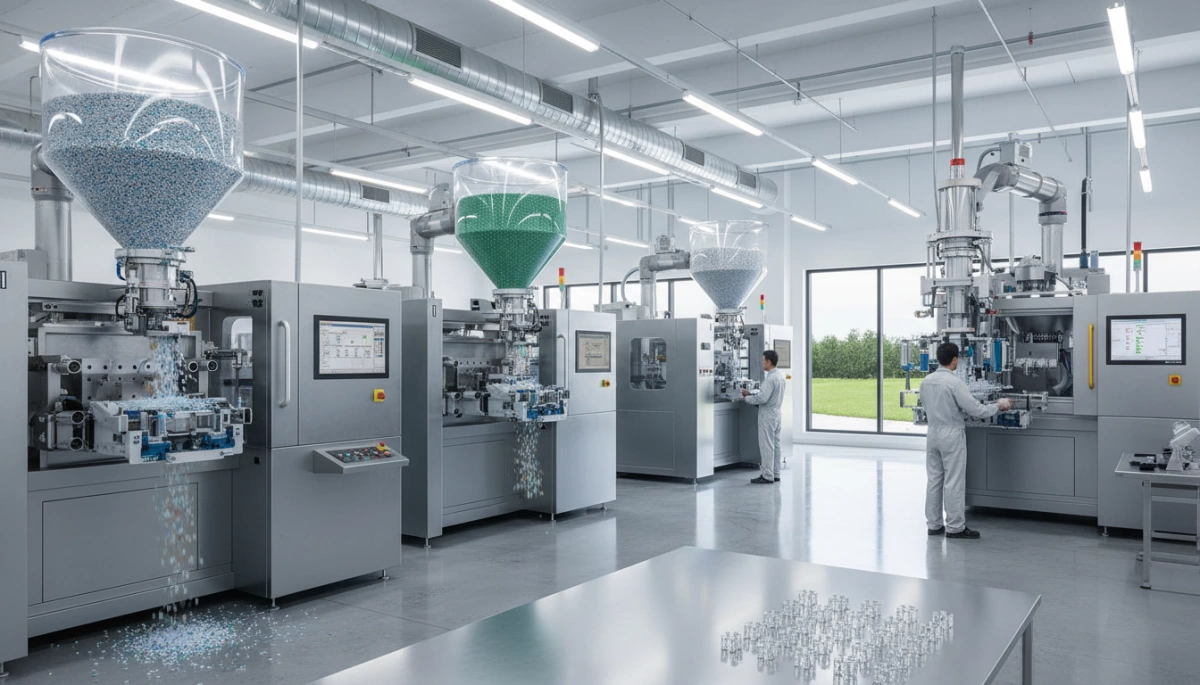
Selecting the right partner for raw material IB injection molding is just as critical as choosing the resin itself. We position ourselves as a digital manufacturing leader, helping you transition seamlessly from early-stage prototyping to high-volume production. Our process is built for speed and flexibility, ensuring you get high-quality parts whether you need a single prototype or 100,000+ units.
We specialize in handling a diverse range of injection blow molding materials, navigating the specific melt flow and thermal stability requirements of complex resins. Our team provides expert guidance on material selection to prevent common issues like blowouts or poor optical clarity.
Key Advantages of Manufacturing with Us
- Speed to Market: We offer rapid turnaround times, delivering parts in as fast as a few days using efficient aluminum tooling strategies.
- Cost Efficiency: Our approach minimizes upfront investment. We use high-quality mold for injection molding machine setups that balance durability with cost-effectiveness.
- No Minimum Order Quantity (MOQ): We support your project at any scale, eliminating barriers for small runs and market testing.
- Scientific Molding: We apply data-driven process controls to ensure consistency across every batch, reducing waste and ensuring tight tolerances.
Proven Success in IB Applications
Our track record speaks for itself. We have executed successful production runs for a variety of demanding applications, including:
- HDPE Packaging: delivering durable, chemically resistant containers by leveraging our deep knowledge of raw material HDPE injection molding.
- PET Pharma Vials: Achieving superior clarity and precise neck finishes for medical-grade requirements.
By combining automated DFM feedback with expert engineering support, we ensure your IBM raw materials perform exactly as intended in the final product.
Frequently Asked Questions About IB Molding Materials
What is the best resin for high-clarity medical containers?
For medical applications requiring superior transparency and chemical resistance, Polycarbonate (PC) and PET are the top contenders. These medical grade IB resins offer glass-like clarity, which is essential for visual inspection of contents, while maintaining the durability needed to withstand sterilization processes. We often recommend these high clarity blow molding plastics because they meet strict regulatory standards while ensuring the structural integrity of vials and bottles.
How does Melt Flow Index (MFI) impact the injection blow process?
The Melt flow index IBM is a critical parameter that dictates how the plastic behaves during both the injection and blowing phases. A resin with an MFI that is too high may flow easily into the mold but lack the melt strength to hold the parison shape on the core rod, leading to sagging or uneven wall thickness. Conversely, a low MFI can make it difficult to fill the injection cavity. When working with flexible materials, understanding the properties of LDPE raw material for injection molding helps in selecting a grade that balances flow with stability.
Can we use recycled materials in injection blow molding?
Yes, sustainable resins injection blow processes are becoming increasingly common. However, using recycled content requires strict quality control to avoid contamination and inconsistent shrinkage rates. We advise blending recycled material with virgin resin to maintain the mechanical properties of the final part. It is also vital to monitor processing parameters closely to control flash in injection moulding, as recycled batches can sometimes exhibit unpredictable flow behaviors compared to virgin stock.
What is the difference between IBM and standard injection molding materials?
While many thermoplastics overlap, injection blow molding materials require higher melt strength and specific stretching capabilities compared to standard injection resins. In standard molding, the material only needs to fill a cavity and cool. In the Polypropylene IB process or when using PET preform materials, the resin must first form a parison and then stretch biaxially without tearing or creating haze. Consequently, IBM raw materials are often formulated with specific additives to enhance their elasticity and thermal stability during the secondary blow stage.
 English
 French
 German
 Spanish
 Italian
 Polish
 Russian
 Japanese
 Korean
 Arabic
 Dutch
 Portuguese
 Swedish
 Norwegian
 Belarusian
 Armenian