
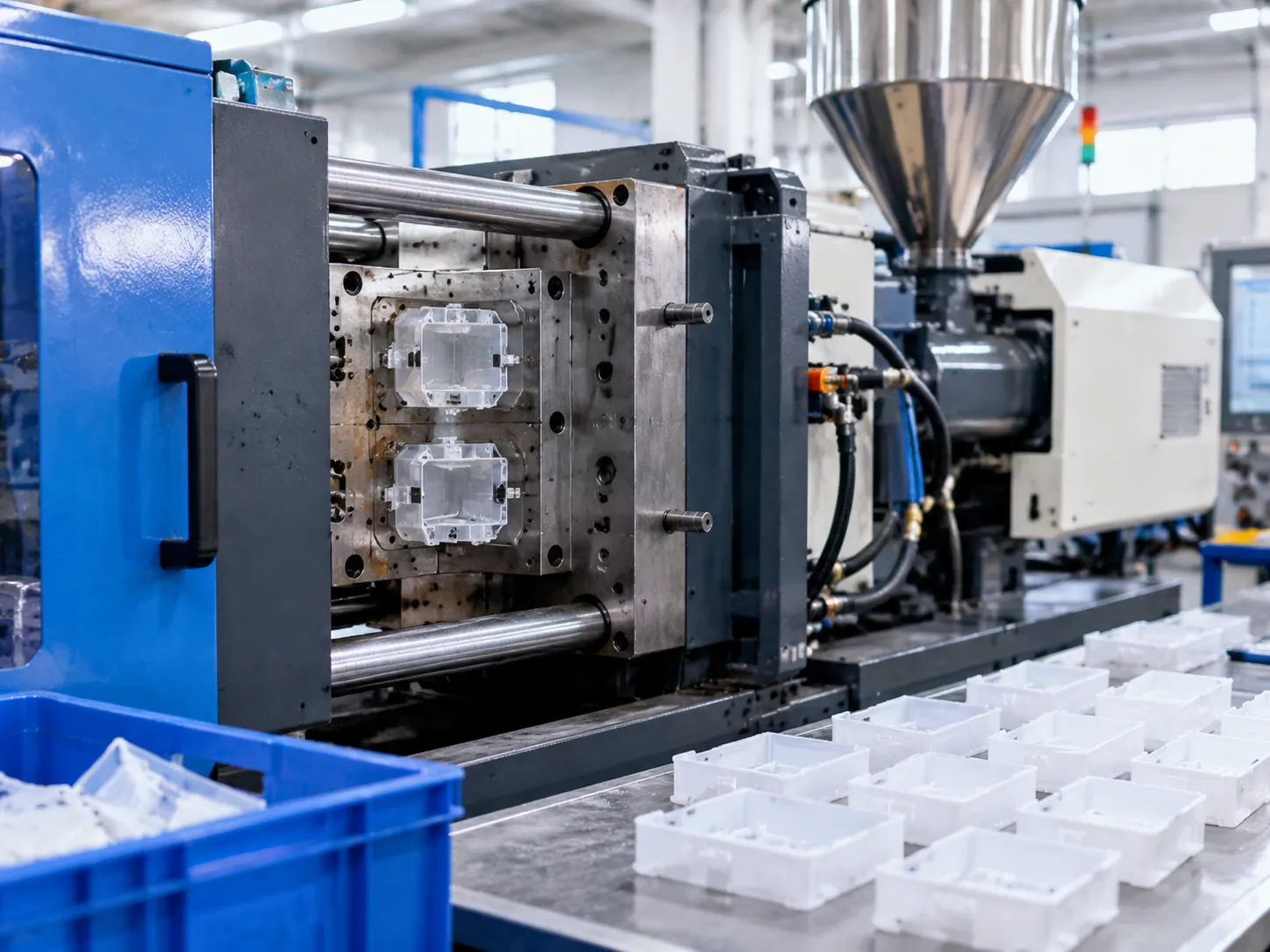
Are you struggling to get flawless, defect-free parts from your production runs?
Getting the process parameters right for ABS injection moulding can make or break your manufacturing budget. One wrong setting in temperature or pressure, and you are left dealing with sink marks, warpage, and costly scrap.
In this guide, you’ll discover the exact design rules, processing settings, and proven troubleshooting tips to master ABS injection moulding od początku do końca.
Zanurzmy się w to od razu.
What Is ABS Plastic in Injection Moulding?
ABS plastic—chemically known as acrylonitrile butadiene styrene—is an opaque thermoplastic terpolymer widely utilized across high-precision industrial manufacturing. As a professional injection molding manufacturer and supplier, we rely heavily on ABS for projects requiring a structural balance of toughness, dimensional accuracy, and aesthetic versatility.
During the ABS injection moulding process, the material transitions smoothly into a molten state without severe thermal degradation, allowing it to flow into complex mold cavities and solidify into highly rigid, impact-resistant components.
Acrylonitrile Butadiene Styrene Composition and Chemical Breakdown
ABS derives its mechanical performance from the synergy of three distinct monomers. By altering the ratios of these building blocks, the resin can be tailored to prioritize impact resistance, heat deflection, or chemical resilience:
- Acrylonitrile (15%–35%): Delivers chemical resistance, fatigue endurance, surface hardness, and thermal stability.
- Butadiene (5%–30%): A synthetic elastomer that provides exceptional impact resistance, ductility, and low-temperature impact retention.
- Styrene (40%–60%): Imparts structural rigidity, high surface gloss, dimensional stability, and smooth melt flow properties during processing.
| Monomer Component | Primary Mechanical Contribution | Influence on Moulding Performance |
|---|---|---|
| Aksylonitryl | Chemical resistance and hardness | Enhances melt strength and solvent tolerance |
| Butadien | Impact strength and fracture toughness | Absorbs structural shocks and prevents brittle cracking |
| Styren | Rigidity and surface finish | Lowers melt viscosity for uniform mold filling |
Why ABS Dominates Custom Rigid Plastic Parts
For engineers and product designers sourcing custom ABS plastic parts, this resin delivers consistent performance across demanding mechanical environments. It bridges the gap between commodity plastics like polypropylene (PP) and expensive engineering thermoplastics like polycarbonate (PC).
We prioritize ABS for custom injection runs because it behaves predictably inside the mold cavity. Its amorphous polymer structure results in minimal, isotropic shrinkage during cooling. This ensures that multi-cavity production runs maintain tight dimensional tolerances, flat surfaces, and crisp edge definition without excessive post-moulding shrinkage variations.
Key Advantages and Engineering Trade-Offs
Selecting the right material requires weighing performance targets against processing realities. In acrylonitrile butadiene styrene moulding, ABS offers significant production benefits alongside a few distinct material limitations:
Major Advantages
- Exceptional Impact Strength: Absorbs mechanical shocks without brittle structural failure, even under repeated loading cycles.
- Superior Surface Aesthetics: Readily accepts diverse textures, high-gloss tooling polish, pad printing, painting, and electroplating.
- High Processability: Exhibits broad processing temperature windows and balanced shear-thinning behavior under pressure.
- Dokładność wymiarowa: Resists post-mold warpage, making it dependable for interlocking enclosures, snap-fits, and structural housings.
Critical Trade-Offs
- Limited UV Resistance: Unmodified ABS degrades, discolors, and becomes brittle under direct sunlight unless compounded with UV stabilizers.
- Solvent Sensitivity: Vulnerable to esters, ketones, and chlorinated hydrocarbons, which cause stress cracking or material dissolution.
- Moderate Thermal Threshold: Lower continuous-use heat deflection temperature compared to unblended engineering resins like PC or nylon.
Essential Material Properties of ABS Resin
When engineering custom ABS plastic parts, understanding the mechanical and thermal baseline of acrylonitrile butadiene styrene is critical. As a professional injection molding manufacturer and supplier, we rely on ABS resin because it delivers an optimal balance of toughness, dimensional accuracy, and finishing versatility.
Impact Resistance and Structural Rigidity Under Stress
ABS combines the strength and rigidity of acrylonitrile and styrene polymers with the toughness of polybutadiene rubber.
High impact strength: Resists cracking, physical shocks, and mechanical abuse, even in sub-zero working conditions.
Flexural stiffness: Withstands dynamic cyclic loads without permanent deformation, making it ideal for rigid mechanical enclosures.
Structural toughness: Distributes mechanical stress efficiently across part geometries to prevent catastrophic failure under sudden load.
Thermal Stability and Heat Deflection Temperatures
Standard ABS provides dependable mechanical performance across moderate thermal environments:
Heat Deflection Temperature (HDT): Typically sits between 85°C and 105°C (185°F to 221°F) under a 0.45 MPa load, depending on the specific resin grade.
Continuous service range: Functions reliably from -20°C up to 80°C in end-use applications without losing structural stiffness.
Stable melt processing: Delivers consistent viscosity throughout the mold cavity during ABS injection moulding cycles.
Dimensional Stability and Low Moisture Absorption
Tight tolerance retention is vital for multi-component assemblies and interlocking enclosures:
Low moisture uptake: ABS exhibits a low 24-hour water absorption rate of 0.2% to 0.4%. Controlling this moisture before melting is critical to avoid cosmetic blemishes, an essential part of diagnosing wad w formowaniu wtryskowym i ich rozwiązań.
Uniform mold shrinkage: Maintains predictable shrinkage rates between 0.4% and 0.7%, allowing tooling engineers to hit tight tolerances across high-volume production runs.
Electroplating and ABS Surface Finish Options
ABS is one of the few engineering thermoplastics readily suited for high-grade decorative and functional surface treatments:
Direct electroplating: The butadiene phase can be etched chemically to create microscopic anchor points, allowing durable adhesion for chrome, nickel, and copper plating.
Tooling surface reproduction: Replicates high-gloss SPI-A finishes, matte textures, and fine Mold-Tech textures straight out of the tool.
Secondary processing: Bonds securely with paints, direct pad printing, ultrasonic welding, and industrial adhesives without aggressive surface pre-treatments.
Core ABS Resin Property Overview
| Właściwość | Typical Value (Standard Grade) | Engineering Benefit |
|---|---|---|
| Wytrzymałość na rozciąganie | 40 – 50 MPa | High load-bearing capacity |
| Moduł sprężysty | 2.1 – 2.7 GPa | Excellent part rigidity |
| Notched Izod Impact | 200 – 350 J/m | Superior crack resistance |
| Heat Deflection Temp (0.45 MPa) | 85 – 105 °C | Good thermal resistance under load |
| Moisture Absorption (24h) | 0.2% – 0.4% | Minimal post-molding dimensional shift |
Crucial ABS Injection Moulding Processing Parameters
Dialing in machine parameters is the foundation for producing clean, stable custom ABS plastic parts. Because ABS is an amorphous polymer, thermal management and pressure balance determine everything from mechanical strength to surface cosmetics. As a professional injection molding manufacturer and supplier, we monitor four critical parameters during each production run to optimize cycle times while balancing the zalety i wady wtryskowego formowania for high-precision components.
Recommended Barrel and Melt Temperature Profiles
ABS processes well across a moderate temperature window, but overheating degrades the butadiene component and weakens impact performance. We maintain a stepped temperature profile along the barrel to plasticize the material steadily without generating thermal burn marks or gas pockets.
- Rear Zone (Feed): 190°C – 210°C (prevents premature melting at the feed throat)
- Middle Zone (Compression): 210°C – 230°C (homogenizes the melt)
- Front Zone (Metering): 225°C – 245°C (readies resin for the shot)
- Dysza: 220°C – 240°C (slightly lower than the front zone to prevent drooling)
- Optimal ABS melt temperature: 220°C – 250°C
Keeping the ABS injection molding temperature within this targeted range prevents polymer chain breakdown and ensures uniform melt viscosity across multi-cavity tools.
Mold Temperature Settings for Surface Gloss and Strength
Tooling temperature directly dictates surface finish, cycle time, and molded-in internal stress. The typical operating range for ABS mold steel is 50°C to 80°C.
- Higher Mold Temperatures (70°C – 80°C): Improve melt front fusion, enhance surface gloss, eliminate weld lines, and reduce residual molded-in stress.
- Lower Mold Temperatures (50°C – 60°C): Speed up cooling cycles for thick-walled components, though they can result in a more matte finish and higher internal stress.
Injection Pressure and Speed Balancing
Zarządzanie ABS injection pressure requires balancing the high viscosity of the resin against the risk of flash and jetting.
- Ciśnienie wtrysku: We generally run ABS between 70 and 120 MPa (700 – 1200 bar) depending on wall thickness, flow length, and gate geometry. Thin-walled geometries require higher pressure to guarantee complete filling before freeze-off.
- Holding / Packing Pressure: Set at roughly 50% to 70% of the primary injection pressure to prevent backflow and compensate for volumetric shrinkage without overpacking the gate.
- Prędkość wtryskiwania: A profiled, multi-stage speed profile works best. We initiate injection at a medium-to-slow speed through the gate to prevent jetting and blush marks, accelerate through thick sections, and decelerate right before mold cavity completion to prevent flash.
Critical Pre-Drying Times and Moisture Control
ABS is hygroscopic, meaning it absorbs ambient moisture from the air. Molding damp pellets leads to silver streaking, splay, structural brittleness, and micro-voids inside the part walls. Reliable ABS resin pre-drying is non-negotiable.
- Moisture Target: Must be kept below 0.05% (preferably under 0.02% for electroplating or high-gloss grades).
- Temperatura suszenia: 80°C – 85°C.
- Drying Duration: 2 to 4 hours in a desiccant dryer.
- Obsługa: Feed pre-dried material directly into closed hopper loaders to stop moisture re-absorption on the shop floor.
ABS Processing Quick-Reference Guide
| Parametr przetwarzania | Target Value Range | Primary Impact on Quality |
|---|---|---|
| Drying Temperature / Time | 80°C – 85°C / 2 – 4 hrs | Prevents splay, foaming, and degraded tensile strength |
| Moisture Content Limit | < 0.05% | Eliminates cosmetic streaks and internal voids |
| Temperatura topnienia | 220°C – 250°C | Controls flowability, viscosity, and degradation |
| Temperatura formy | 50°C – 80°C | Dictates surface gloss, weld line strength, and cycle time |
| Ciśnienie wtrysku | 70 – 120 MPa | Ensures complete cavity filling without flash |
| Siła utrzymująca (Holding Pressure) | 40 – 70 MPa | Compensates for shrinkage and prevents sink marks |
| Ciśnienie zwrotne | 5 – 15 MPa | Ensures uniform melt density and color dispersion |
Design Rules for ABS Injection Moulded Parts
Producing high-grade ABS injection moulding components requires strict adherence to part geometry standards. Because ABS expands and contracts during thermal transitions, following proven ABS mold design guidelines ensures your parts maintain structural integrity, avoid visual defects, and eject smoothly during production runs.
Uniform Wall Thickness to Eliminate Sink Marks
Maintaining a uniform ABS wall thickness is critical for consistent cooling rates and dimensional stability. Sudden shifts in wall thickness trigger localized thermal contraction, producing internal voids or visible sink marks in ABS parts.
- Nominal Thickness Range: Keep nominal walls between 1.5 mm and 3.5 mm for balanced flow and structural strength.
- Stopniowe przejścia: When wall thickness must vary, transition gradually using a 3:1 taper to prevent flow disruptions.
- Coring Out Thick Sections: Remove excess mass from heavy zones to maintain consistent wall sections across the entire part.
| Wall Geometry Feature | Standard Specification | Cel |
|---|---|---|
| Nominal Wall | 1.5 mm – 3.5 mm | Balanced melt flow and rapid cycle times |
| Wall Transition | ≤ 25% change with 3:1 slope | Prevents stress concentration and warpage |
| Coring Sections | Hollow thick cross-sections | Eliminates internal voids and sink marks |
Optimal Draft Angles for Clean Mold Ejection
Providing a proper draft angle for ABS plastic allows components to release easily from the core and cavity without surface scraping or part distortion. When we zaprojektować formę do wtrysku, applying correct draft tapers directly reduces ejection force and cycle delays.
- Polished/Smooth Faces: Apply a minimum draft of 1° to 1.5° per side.
- Teksturowane powierzchnie: Add 1° of draft for every 0.025 mm (0.001 in) of texture depth to prevent scuff marks.
- Deep Draw Features: Maintain at least 2° of draft on deep ribs and vertical walls to ensure clean ejection.
Rib and Boss Guidelines for Structural Integrity
Reinforcing features provide stiffness and support fasteners without unnecessarily thickening the nominal walls. Improperly sized ribs and bosses, however, cause severe surface sinks on the cosmetic side of the part.
- Rib Base Thickness: Limit rib thickness to 50% to 60% of the adjacent nominal wall thickness.
- Rib Height: Keep height below 3 times the nominal wall thickness to prevent buckling and trapped gases.
- Boss Proportions: Maintain boss outer wall thickness at 60% of the adjacent wall. Support freestanding bosses with gusset ribs rather than increasing wall mass.
Corner Radiusing and Fillet Transitions
Sharp internal corners act as stress concentrators that lead to premature mechanical failure, high mold wear, and stress cracking under dynamic loads.
- Internal Radii (R): Set the internal radius between 50% and 60% of the nominal wall thickness (minimum 0.5 mm).
- 50% grubości nominalnej ściany Set external radii equal to the internal radius plus the wall thickness to preserve uniform thickness around the curve.
- Optymalizacja przepływu: Generous corner fillets streamline melt flow within the cavity, reducing molded-in stress and filling pressure.
Common ABS Injection Moulding Defects and Troubleshooting
As a professional injection molding manufacturer and supplier, we regularly optimize processing windows to prevent cosmetic and structural flaws. ABS offers a forgiving processing window, but shifts in temperature, injection pressure, or moisture levels can instantly degrade part consistency. Diagnosing these wad w formowaniu wtryskowym i ich rozwiązań steps early keeps production cycles fast and scrap rates low.
Fixing Sink Marks and Localized Shrinkage Issues
Sink marks occur when heavy cross-sections cool and shrink inward away from the mold surface. To eliminate sink marks in ABS parts:
- Boost Packing and Holding Pressure: Increase secondary packing pressure and holding time to push extra resin into thick areas before gate freeze occurs.
- Control Melt Temperature: Lower the ABS melt temperature within recommended ranges to shorten internal cooling times and minimize volumetric contraction.
- Optimize Part Geometry: Follow strict ABS mold design guidelines by ensuring ribs and bosses are 40% to 60% of the nominal ABS wall thickness.
- Enlarge Gates: Open up restricted gates to prevent premature gate freezing during the holding phase.
Eliminating Warpage Caused by Uneven Cooling Rates
Warpage stems from differential shrinkage across the part, often triggered by temperature imbalances between mold halves.
- Balance Tooling Temperatures: Keep the temperature differential between the cavity and core plates under 5°C to 10°C.
- Wydłuż czas chłodzenia: Let parts solidify fully inside the clamped mold before driving ejection pins into the part.
- Redistribute Gate Locations: Move injection points to promote linear, balanced melt front progression and reduce residual internal stresses.
- Verify Wall Uniformity: Avoid abrupt step changes in thickness that create unbalanced cooling zones.
Preventing Silver Streaks and Splay Marks from Residual Moisture
Silver streaking or splay is primarily caused by trapped moisture vaporizing in the barrel during the shot.
- Enforce Strict ABS Resin Pre-Drying: Dehumidify raw ABS pellets for 2 to 4 hours at 80°C to 85°C before processing, ensuring moisture content stays strictly below 0.05%.
- Check Barrel Decompression: Avoid excessive screw suck-back, which can draw ambient air through the machine nozzle.
- Lower Shear Heating: Reduce excessive injection speed and screw back-pressure to stop localized resin overheating.
Correcting Weld Lines, Flash, and Short Shots
| Wada | Przyczyna źródłowa | Immediate Production Fix |
|---|---|---|
| Linie spawalnicze | Cold melt fronts meeting and failing to fuse completely. | Raise mold temperature, increase injection speed, and optimize cavity venting at flow convergence points. |
| Wypływki | Resin forcing its way between tool parting lines due to over-pressurization. | Niższy ABS injection pressure, verify machine clamping tonnage, and check tooling parting surfaces for wear or debris. |
| Niedostateczne napełnienie | Incomplete cavity filling before the melt cools and freezes. | Increase shot size, step up injection speed, raise melt temperature, and expand undersized runners or gates. |
ABS vs Alternative Resins for Injection Moulding
Selecting the right polymer comes down to balancing structural demands, environmental exposure, and tooling budgets. While ABS injection moulding delivers an exceptional balance of mechanical rigidity and aesthetic quality, alternative engineering thermoplastics offer distinct trade-offs.
| Materiał | Key Strengths | Main Limitations | Typowe zastosowania |
|---|---|---|---|
| ABS | Easy processing, high rigidity, low cost, excellent surface finish | Moderate heat resistance, vulnerable to strong solvents | Housings, consoles, consumer electronics |
| PC (poliwęglan) | Exceptional impact strength, optical clarity, high heat limits | Higher processing temperatures, prone to stress cracking | Lenses, light pipes, bulletproof shields |
| PP (Polipropylen) | Superior chemical resistance, living hinge capability, low density | High shrinkage, lower stiffness, difficult to paint | Caps, containers, chemical tanks |
| PA (Nylon) | Outstanding wear resistance, low friction, high tensile strength | Absorbs moisture readily, dimensional instability | Gears, bearings, structural brackets |
| PC/ABS Blend | High heat deflection, extreme impact toughness, good flow | Higher raw material cost than pure ABS | Automotive interiors, rugged enclosures |
ABS vs Polycarbonate (PC): Impact Strength and Heat Resistance
Podczas oceny ABS vs PC injection moulding, impact resistance and thermal performance are the decisive factors:
- Impact and Strength: Polycarbonate can withstand severe dynamic loads and near-shattering impacts that would crack standard ABS.
- Wykroczność temperaturowa: PC handles continuous service temperatures well above standard thermal limits, whereas unmodified ABS softens under lower thermal thresholds.
- Mouldability and Cost: ABS requires significantly less injection pressure and lower melt temperatures, reducing cycle times and tooling wear while lowering overall material costs.
ABS vs Polypropylene (PP): Rigidity versus Chemical Flexibility
The choice between ABS and polypropylene hinges on dimensional stability versus environmental resistance:
- Structural Rigidity: ABS provides the structural stiffness and tight tolerances required for precision snap fits and rigid enclosures. PP is inherently more pliable and exhibits higher post-mould shrinkage.
- Odporność chemiczna: Polypropylene resists harsh industrial chemicals, strong solvents, and bases that can degrade ABS surfaces.
- Wykończenie powierzchni: Custom ABS parts accept paint, pad printing, and chrome plating readily, while PP requires aggressive flame or plasma surface treatments to achieve basic paint adhesion.
ABS vs Nylon (PA): Wear Resistance and Moisture Sensitivity
For mechanical assemblies, nylon and ABS serve entirely different design priorities:
- Friction and Abrasion: Polyamide (PA) is the preferred engineering resin for continuous sliding contact, internal drive gears, and high-friction components.
- Hygroscopic Stability: Nylon absorbs substantial moisture directly from the air, which alters part dimensions and weakens structural stiffness over time. ABS remains dimensionally stable under shifting humidity conditions.
PC/ABS Blends: Enhancing Toughness and Thermal Thresholds
Compounding ABS with polycarbonate bridges the performance gap between these two resins. A PC/ABS blend delivers:
- Higher heat deflection limits compared to general-purpose ABS.
- Superior low-temperature ductility and drop-impact resistance.
- Retained flowability during the fill phase, preventing extreme pressure drops across thin-walled sections.
We run standard ABS, specialized grades, and advanced alloys to match exact functional specifications. As a team that continually zwiększa moce produkcyjne odlewów, we optimize tooling parameters and resin selection to keep production cycles fast and part tolerances consistent.
Typical Applications of Injection Moulded ABS Components
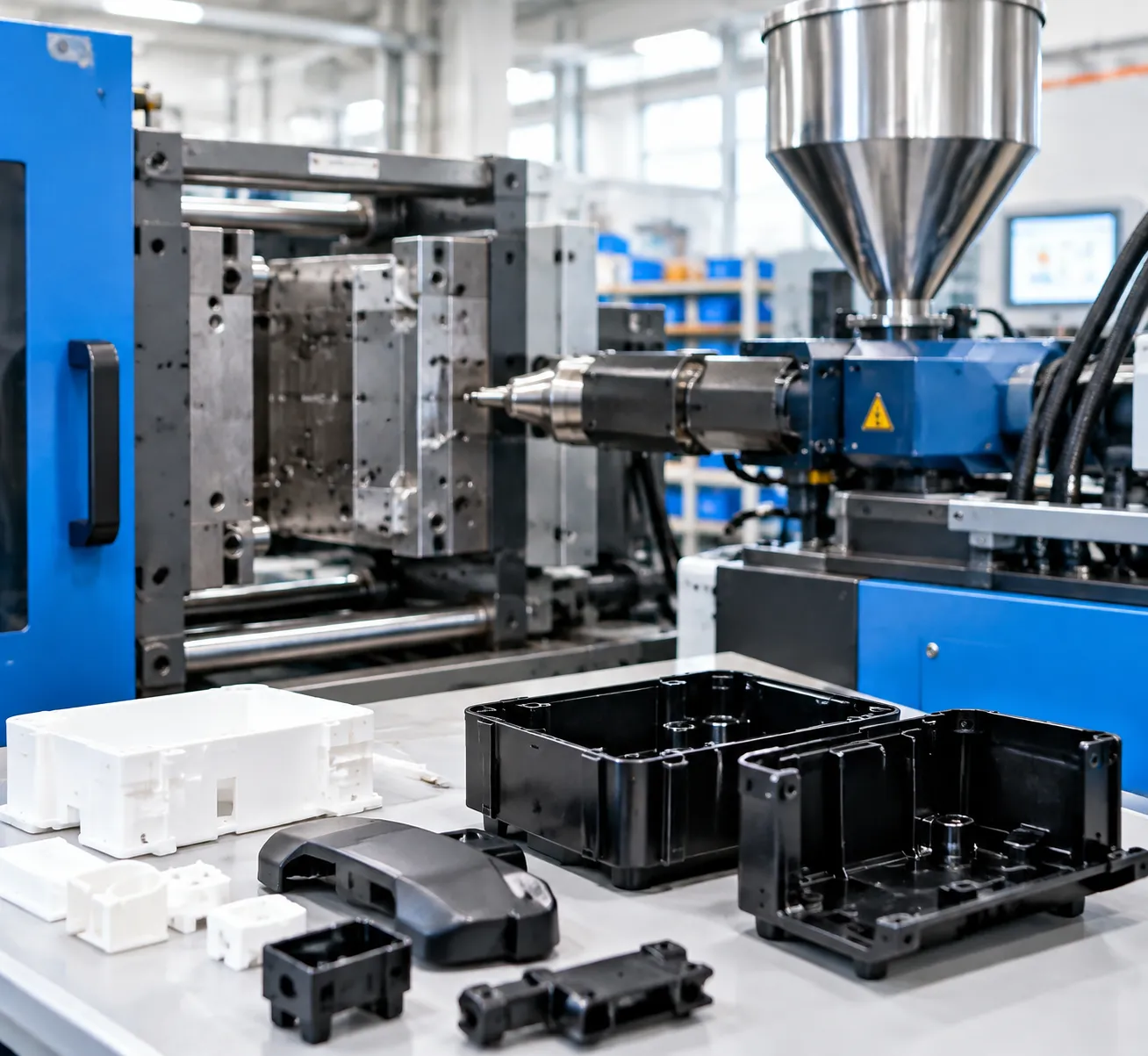
We rely on ABS resin whenever a project demands high impact resistance, rigidity, and predictable dimensional stability. We are a professional injection molding manufacturer and supplier, producing durable custom ABS plastic parts tailored to strict global industry standards. When determining how ABS can be injection moulded for structural or decorative products, several key sectors take full advantage of its versatile properties.
Automotive Interior Panels, Consoles, and Trim Components
Vehicle cabins require tough materials that handle regular physical contact, vibration, and thermal shifts without cracking or fading:
Dashboard panels and instrument bezels: ABS maintains structural rigidity and supports tight assembly tolerances.
Center console assemblies: Provides scratch resistance and supports textured mold finishes.
Air vent louvers and control knobs: Retains dimensional stability during temperature fluctuations.
Interior aesthetic trims: Readily accepts electroplating, matte painting, or custom graining.
Consumer Electronics Enclosures and Computer Housings
Electronics enclosures must shield delicate internal circuitry while providing a modern, clean exterior:
Monitor bezels and laptop shells: Rigid structures that resist flexing, drops, and handling stress.
Networking equipment enclosures: Delivers consistent dimensional control for snap-fit joints and connector cutouts.
Keyboard keycaps and peripheral frames: Wear-resistant surfaces that withstand millions of actuation cycles.
Household Appliance Components and Power Tool Casings
Appliances and hand tools face continuous motor vibrations, drops, and mechanical shock:
Power tool body shells: Drills, grinders, and impact drivers leverage ABS to absorb direct impacts.
Vacuum cleaner bodies: Lightweight, rigid structures that withstand repeated collisions and high stress.
Kitchen appliance bases: Food processors, blenders, and coffee makers that utilize various ABS surface finish options for easy cleaning.
Protective Equipment, Pipe Fittings, and Toy Assemblies
ABS performs reliably under demanding utility and consumer recreation requirements:
Safety helmets and protective gear: Hard hats and protective shells designed to dissipate blunt impact energy.
Plumbing and electrical conduit fittings: Rigid pipe systems that withstand stress without brittle failure.
Modular toy assemblies: Interlocking building bricks that depend on strict tolerances and mechanical retention.
| Sector | Representative Parts | Core Functional Demand |
|---|---|---|
| Motoryzacja | Consoles, door trim bezels, vent louvers | Impact absorption, low-gloss aesthetics, dimensional stability |
| Elektronika | Router housings, monitor frames, keyboard shells | Snap-fit integrity, fine cosmetic surface, drop protection |
| Tools & Appliances | Tool clamshells, vacuum bodies, blender bases | High yield strength, fatigue resistance, ergonomic finish |
| Consumer & Utility | Protective helmets, pipe fittings, model assemblies | Toughness under stress, precise fit, wear resistance |
Frequently Asked Questions About ABS Injection Moulding
What is the typical shrinkage rate for ABS plastic during moulding?
The standard ABS shrink rate ranges between 0.4% and 0.7% (0.004 to 0.007 mm/mm). Because ABS is an amorphous polymer, it exhibits minimal, uniform volumetric shrinkage compared to semi-crystalline resins like polypropylene or nylon. This predictable dimensional stability allows us to hold tight tolerances on complex parts, provided wall thicknesses remain uniform across the part geometry.
Does ABS plastic require pre-drying before injection processing?
Yes. ABS resin is hygroscopic and readily absorbs atmospheric moisture. Processing resin with excessive moisture leads to splay marks, cosmetic silver streaking, and reduced impact strength. Proper ABS resin pre-drying requires desiccant drying at 80°C to 85°C (176°F to 185°F) for 2 to 4 hours, bringing the moisture content strictly below 0.05% to 0.1% before entering the feed throat.
Can recycled or regrind ABS be used in injection moulding?
Clean regrind ABS can be incorporated into production runs, typically blended with virgin resin at ratios between 10% and 20%. Exceeding this limit can cause thermal degradation, inconsistent melt flow, and reduced impact resistance. Maintaining exact screw recovery and barrel heat control on a well-maintained używanej maszyny do wtrysku plastiku na sprzedaż ensures that regrind blends melt evenly without degrading base polymers.
What surface finishes can you achieve with ABS moulded parts?
ABS delivers exceptional versatility when it comes to exterior surface finishing:
- High-Gloss Polish: Achieves mirror-grade finishes up to SPI A-1 and A-2 standards.
- Molded Textures: Readily accepts standard SPI, VDI 3400, and Mold-Tech textures to hide wear and fingerprints.
- Secondary Finishing: Highly compatible with electroplating (chrome plating), ultrasonic welding, pad printing, and painting without special surface primers.
How does tooling temperature influence the mechanical properties of ABS?
Tooling temperature directly dictates part stress, surface finish, and weld line integrity. Running mold temperatures in the higher recommended range (60°C to 80°C) allows slower cooling, which improves polymer chain packing, yields higher surface gloss, and strengthens weld lines while reducing molded-in residual stresses. Running colder molds (below 40°C) reduces cycle times but increases the risk of part warpage and premature failure under impact stress.
 Polish
  English
  French
  German
  Spanish
  Italian
  Russian
  Japanese
  Korean
  Arabic
  Dutch
Dutch  Portuguese
  Swedish
  Norwegian
  Belarusian
  Armenian